

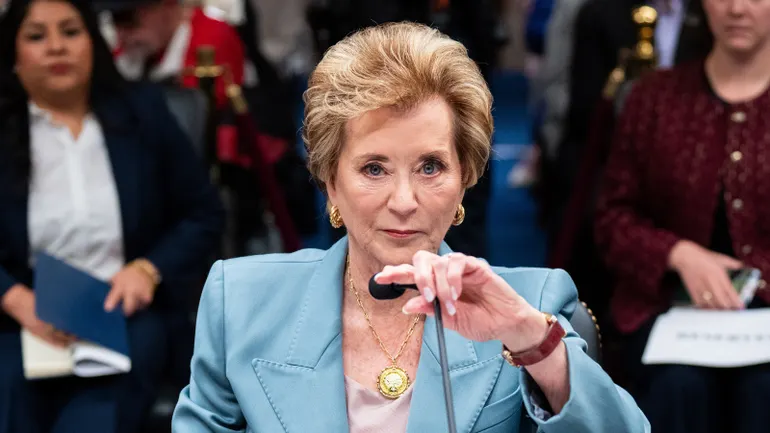
WASHINGTON — A year into her position as U.S. education secretary, Linda McMahon appeared in front of a Senate subcommittee Tuesday to promote a fiscal year 2027 budget proposal that she said continues to shrink “our bloated bureaucracy” and give more education decision-making to state and local leaders.
“Today, I can confidently attest that we are delivering on the vision of educational renewal that, for decades, many promised but none have delivered,” McMahon said.
Although the hearing focused on next year’s budget proposal, McMahon faced tough questions from Democratic members of the Senate Subcommittee on Labor, Health and Human Services, Education and Related Agencies over significant changes made under her leadership in the past year. Among them: withholding federal K-12 grant funding last summer, reducing the workforce in the Office for Civil Rights, and outsourcing Education Department activities to other federal agencies.
“Secretary McMahon, instead of working collaboratively towards solutions to help our students and families, you have undertaken a politically motivated campaign to undermine the work of the Department of Education,” said Sen. Tammy Baldwin, D-Wis., ranking member of the subcommittee. “This has been to the detriment of our students and, if allowed to continue, will have consequences long into the future.”
‘Make Education Great Again’
The Trump administration proposes funding the U.S Department of Education at $76.5 billion for FY 2027, a 3% cut compared from FY 2026 funding level of $79 billion. The proposal would level fund Title I at $18.4 billion and increase special education funding by $539 million to $16 billion.
The fiscal plan repeats attempts from the Trump administration’s FY 26 proposal to eliminate some existing grants while consolidating others into single funding streams for states to distribute at their own discretion — moves ultimately rejected by Congress when it approved the final budget in February that was signed into law by President Donald Trump.
For example, the FY 27 budget plan recommends consolidating 17 K-12 grant funding streams worth $6.5 billion into a single $2 billion grant program named Make Education Great Again. This would give states and districts flexibility to determine what priority areas to fund based on their needs, McMahon said.
“We’ve been clear: Shifting authority back to the states will not come at the expense of essential federal programs for support, much of which predate the department itself,” McMahon said.
Several lawmakers asked McMahon what the department was doing to increase student achievement. She said that through the proposed Make Education Great Again program, states would be required to reserve at least 25% to support literacy initiatives and set aside another 25% for math instruction.
The remaining funds could be used by states to support any activities currently allowable under the 17 formula and competitive K-12 grant programs targeted for elimination.
Several Republican subcommittee members praised parts of the spending proposal that would hand more fiscal authority to states and districts.
“We find ourselves at a crossroads,” said Subcommittee Chair Shelley Moore Capito, R-W.Va. “Do we stay the course with our education system as it is, hoping that more money and federal intervention will solve our problems? Or do we, as you have suggested, ask the difficult questions and consider innovative solutions that can actually turn the tide?”
What’s next for interagency agreements?
While the FY 27 proposal does not detail additional moves to transfer Education Department responsibilities to other federal agencies, McMahon was questioned about the status of the 10 interagency agreements already underway.
When asked by Sen. Patty Murray, D-Wash., vice chair of the full Senate Appropriations Committee, about the status of potentially moving special education programming to other agencies, McMahon said no decisions have been made. Nonetheless, she said the agency is exploring placing some programs that support the Individuals with Disabilities Education Act at the U.S. Department of Labor and others with the U.S. Department of Health and Human Services.
Murray said she has received a petition with thousands of signatures from parents, educators and advocates in protest of moving IDEA services out of the Education Department.
“I can assure you that the intent of this administration is not to put these students at risk in any way whatsoever,” McMahon said.
For the current interagency agreements, McMahon acknowledged there have been some “hiccups” with the moves. However, she added that the same Education Department employees who worked on specific grant programs are still doing those jobs, just at different federal buildings.
Addressing the agreement between the Education and Labor departments for certain Elementary and Secondary Education Act programs, McMahon said, “this is a program that I believe will help our students as they go from K through 12 into higher education be prepared for the workforce of today and the demands of the workforce of tomorrow.”
Sen. Mike Rounds, R-S.D., praised the Education Department’s work to create interagency agreements.
“I like the idea that those decisions should be made at the local level,” Rounds said. “And I think there’s a number of areas within the Department of Education that we’ve been working on through legislation, trying to divvy back out again to the departments that they were in before the department was ever created.”
The status of OCR
Several Democratic lawmakers asked McMahon about the agency’s progress in addressing OCR complaints. The FY 27 proposal recommends reducing staffing from 530 in FY 25 to 271 in FY 27 and shrinking the office’s budget from $140 million in FY 25 to $91 million in FY 27.
Before Tuesday’s hearing, Sen. Bernie Sanders, I-Vt., released a report critical of inaction at OCR. The report said that although the agency had the same budget in 2025 as the year before, OCR only provided relief to students and families through resolution agreements in just 1% of its 11,985 pending cases.
The report said that in 2025, OCR issued nearly 79% fewer disability resolution agreements for students with disabilities, compared to the year before.
Sen. Chris Murphy, D-Conn., questioned McMahon about the status of OCR complaints during Tuesday’s hearing. McMahon said there was a backlog of 19,000 OCR complaints at the beginning of last year. She added that the agency is rehiring many of the lawyers that worked on OCR cases who were part of an agencywide reduction-in-force last year.
“There was a time when we were not processing cases as quickly as we should, but we are now focused on doing that and moving forward,” McMahon said. “We expect to see progress.”
Tuesday’s hearing was just one part of the multistep budget approval process. The House version of the FY 27 Labor, Health and Human Services, Education and Related Agencies bill will be marked up by that chamber’s full Appropriations Committee on June 9.
FY 27 starts Oct. 1.
