

Get stories like this delivered straight to your inbox. Sign up for The 74 Newsletter
It was only three months ago that Congress rejected the Trump administration’s last attempt to slash education spending and roll an array of programs into a block grant.
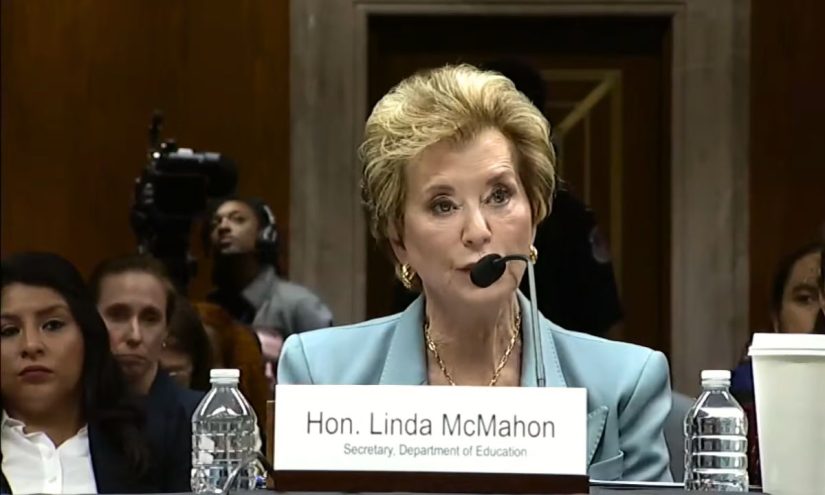
From the reception that some members of the Senate Appropriations Committee gave U.S. Education Secretary Linda McMahon on Tuesday, it appeared not much has changed.
Both Republicans and Democrats grilled the secretary over the Trump administration’s plan to cut funding for rural schools and programs that help low-income students enter and complete college.
Consolidating $220 million for rural education with 16 other programs — including literacy grants, education for homeless students and afterschool programs — into a $2 billion Make Education Great Again grant program would “undermine the goals of helping our K through 12 schools,” Republican Sen. Susan Collins of Maine, chair of the committee, told McMahon. “Protecting rural schools and rural communities has always been one of my top priorities.”
Throughout the two-hour hearing, McMahon defended the president’s $76.5 billion 2027 budget request, saying that although “it is a reduction,” the block grant proposal — a long time goal for conservatives — would give states more say over how to spend federal dollars. The so-called MEGA grant program will prioritize reading and math, McMahon said, and “unleash momentous opportunity for every child to realize their God-given potential.”
The budget would maintain funding for Title I, serving high-poverty schools, at $18.4 million, and boost spending for students with disabilities by over $500 million.
But the proposal includes a 35% cut to the Office for Civil Rights and eliminates some programs completely. Those include $428 million in services for migrant children and what is known as TRIO, a batch of programs that prepare students for higher education as early as middle school.
“I oppose the administration’s proposal to … eliminate a program that enjoys robust support and has made such a difference in the lives of children,” Collins said, noting that three of her staff members would not have attended college without TRIO.
Republican Sen. Susan Collins of Maine is among those opposed to cutting programs that prepare low-income students for college.
She was among the six Republicans and six Democrats who sent McMahon a letter earlier this month objecting to how the department has altered two of the TRIO grants to direct students toward the workforce instead of college.
“College is not the only solution for everyone,” McMahon told the members.
Sen. Jeff Merkley, a Democrat from Oregon, cited data showing that low-income, high school students who participate in Upward Bound are more than twice as likely to earn a bachelor’s degree by age 24 than their peers who don’t participate.
“The stats from these programs are pretty damn impressive,” he said.
Even Sen. Mike Rounds of South Dakota, who has authored one of the bills that would eliminate the Education Department, called TRIO a “sensitive area” and urged McMahon to consider the committee’s concerns.
Other Republicans praised the secretary for continuing efforts to shut down the department in the face of extensive criticism.
“You are so cool, literally and figuratively,” said Sen. John Kennedy of Louisiana. “They call you names, and you just ignore them.”
Before Special Ed, There Was the School-to-Asylum Pipeline. How One Lawsuit Helped End It
‘50 years of progress’
To some Democrats, McMahon has also turned her back on parents who don’t want to see special education offloaded to another agency. The secretary said her team still hasn’t decided what would happen to programs that fall under the Individuals with Disabilities Act. Some might go to the Department of Labor, while others could go to the Department of Health and Human Services, she said.
“I’ve gotten a petition from thousands of parents, educators, advocates who are concerned that will really undermine 50 years of progress in making sure the rights of children and students with disabilities are met,” said Sen. Patty Murray of Washington, ranking member of the committee.
Both Murray and Sen. Chris Murphy of Connecticut clashed with McMahon over the way her staff has handled civil rights enforcement.
“How do you defend that not a single child in Connecticut got a positive resolution from the Department of Education for their discrimination claims?” Murphy asked her. “Seventy of them had disability claims.”
While he’s not on the committee, Sen. Bernie Sanders of Vermont, an independent, released a report Tuesday calling McMahon’s OCR “the least productive in over a decade.” The document notes that the office reached “zero resolution agreements for students facing serious traumatic incidents including sexual harassment, sexual violence, seclusion, restraint, racial harassment and discriminatory school discipline.”
He cited a January government watchdog report showing that putting OCR staff on paid leave last year, after she tried to fire them, cost taxpayers at least $38 million.
To Ease Civil Rights Backlog, McMahon Orders Back Staff She Tried to Fire
McMahon insisted that the administration was ramping up efforts to address such complaints and seemed confused that the president calls for a $49 million cut to OCR, bringing the budget to $91 million.
“That’s a floor number,” she said. “Hopefully we’ll have the ability to increase that number.”
She ordered OCR staff on leave to return in December to address a backlog of cases, and is now hiring supervisors and attorneys for regional offices. An internal memo, shared with The 74, shows the regional directors would go to Denver, Seattle and the D.C. offices. But according to an OCR attorney, who asked not to be named for fear of retaliation, there have been “lots of departures” among those McMahon brought back.
‘Overdue for a debate’
Some who watched the exchanges between McMahon and the committee Tuesday were struck by the level of bipartisanship over the TRIO program.
“It shows the kind of Congressional support these programs have built up over many years, and the strong constituencies they have behind them,” said Maureen Tracey-Mooney, associate director of FutureEd, a Georgetown University think tank. Previously, she led K-12 policy development for the Biden White House.
She added that the programs that McMahon aims to wrap into the MEGA program “focus on the most vulnerable student groups.”
Those would include students who need after-school care and are currently served by the 21st Century Community Learn Centers program.
“What do you do once they leave the classroom when they’re so young and they can’t obviously take care of themselves at home?” asked Republican Sen. Shelley Capito of West Virginia.
McMahon responded that it would be up to states to decide whether after-school programs are a priority for them.“We’re certainly overdue for a debate about how to best support our nation’s students,” Tracey-Mooney said. “But I think we are unlikely to see a rigorous engagement in Congress with these ideas through the budget process.”
Did you use this article in your work?
We’d love to hear how The 74’s reporting is helping educators, researchers, and policymakers. Tell us how
