

By: Riley Black
Your feed is loaded with glowing reviews of the latest AI-powered teaching tools. They promise to save you time by assessing student work, creating customized curriculum, or writing multilingual parent newsletters.
Your students have access to personalized AI tutors, automated writing and editing tools, podcast generators, research assistants, virtual labs and field trips, and multimodal textbooks.
The bounty of educational technology is undeniable. There is just one problem. The workflow of school is unchanged. This means the loudly touted benefits of AI have not been felt.
The core structure of what we would recognize as a ‘traditional’ K–12 classroom instruction has been in place for more than a century. It is so ingrained in our cultural practices that it is almost impossible to view objectively.
We may need an outside observer to see it clearly.
Educators who have worked with me over the decades have remarked on multiple occasions that I behave very much like Star Trek’s Mr. Spock. I interact with humans but I don’t understand them. So let me embrace my inner Spock and describe, procedurally, what a school day looks like to a non-human observer.
From there, we can reimagine what the workflow of school could look like if we really wanted to maximize the effectiveness of the AI tools we have at our disposal.
What School Looks Like Now
To: Epsilon Eridani Education Hive
From: Humanshell Ross #ID 19195512
In Re: Terran Education Systems
The instructional environment is highly structured and time-segmented. The earth school day is divided into discrete intervals, each governed by externally imposed signals such as bells or scheduled transitions. Human subjects identified as “students” move in coordinated groups between physical locations, while a designated authority figure, the “teacher,” remains fixed within a defined instructional space. The teacher initiates and terminates most activities, regulates pacing, and controls access to resources and discourse.
Within the instructional interval, communication follows a patterned sequence. The teacher frequently occupies the role of primary information transmitter, delivering content verbally or through visual display systems. Students alternate between passive reception and prompted responses. These responses are often prompted through questions that have pre-established correct answers. Participation is unevenly distributed, with a subset of students responding publicly while others remain silent but are still subject to evaluation.
Written artifacts, on paper or digital devices, are produced as evidence of engagement and comprehension.
Behavioral norms are explicitly and implicitly enforced. Students are expected to maintain physical stillness for extended periods, orient their attention toward the teacher or assigned task, and regulate peer-to-peer interaction unless permitted. Compliance is monitored continuously. Deviations, such as unauthorized movement or communication, are corrected through verbal cues or other behavioral interventions. Positive reinforcement is occasionally applied, though correction is more frequent than affirmation in maintaining group order.
Assessment mechanisms are embedded throughout the process. The teacher collects observable outputs, including verbal responses, written work, and task completion indicators, to infer internal cognitive states. These inferences are recorded and translated into quantitative measures. The accumulation of these measures appears to influence future opportunities and categorizations of student capability.
The overall system exhibits characteristics of centralized control, standardized sequencing, and constrained interaction. Individual variation among students is present but is managed within the boundaries of the procedural framework. The system’s primary function is the transfer, rehearsal, and verification of knowledge and skills within a fixed temporal and spatial structure.
Recommendation: Reallocate resources to more promising systems.
What School Could Look Like
That’s what an alien would see. This is what one nominally human expert would propose.
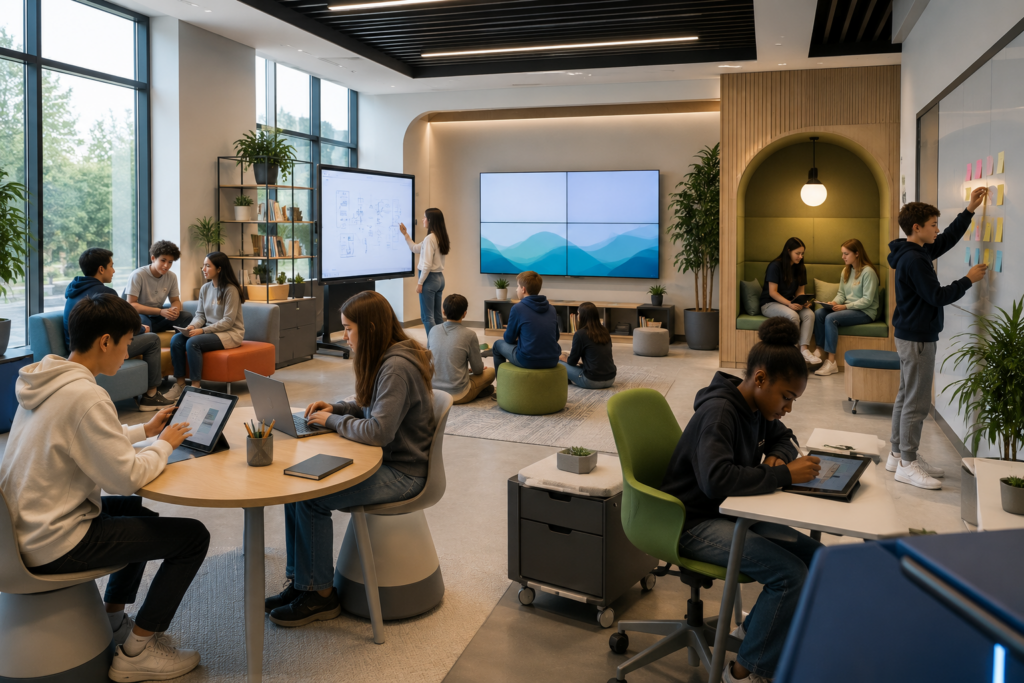
The most immediate shift is the removal of synchronized time blocks and whole-group pacing. Learners no longer move through a fixed schedule; instead, they operate within a continuously adaptive learning environment.
An AI orchestration layer monitors progress across competencies and dynamically assigns tasks, resources, and collaborators. Platforms such as Khan Academy’s Khanmigo, Muzzy Lane-powered simulation environments, or OpenAI-based tutoring agents (Praktika.ai, for example) function as always-on guides, adjusting difficulty, prompting reflection, and surfacing misconceptions in real time. The day becomes a fluid progression of learning states rather than a series of clock-bound activities.
The role of the teacher transforms into that of a systems designer and intervention specialist. Rather than delivering content, the teacher configures learning pathways, curates tools, and monitors real-time data across domains.
Tools like Google Classroom analytics, Canvas with AI plugins, or custom dashboards built on top of OpenAI APIs provide visibility into student thinking, not just outputs. The teacher intervenes selectively, focusing on moments where human judgment, ethical reasoning, or emotional support is required.
Instructional content is no longer delivered as static lessons but as interactive, multimodal experiences generated on demand. A learner studying ancient Egypt could enter a real-time simulation generated by platforms like Unreal Engine paired with generative AI. There, they interact with historically grounded characters powered by conversational models
Instead of reading about irrigation systems, the learner experiments within a simulated Nile environment, testing variables and receiving immediate feedback. Knowledge acquisition becomes inseparable from application and experimentation.
Assessment shifts from periodic evaluation to continuous evidence capture. Every interaction with an AI system generates data about reasoning processes, decision-making patterns, and persistence. Tools such as Turnitin’s AI writing analytics, ETS-style competency models, or emerging “process-based assessment” platforms track how a learner arrives at an answer, not just whether the answer is correct. Portfolios are automatically constructed, containing annotated transcripts, drafts, revisions, and reflections that demonstrate growth over time.
Collaboration is restructured through intelligent grouping systems. AI agents analyze learner profiles and assemble teams based on complementary strengths, cultural perspectives, and working styles. Within these teams, each learner may be supported by a personalized AI copilot, such as a Gemini-based agent configured for specific roles like fact-checking, design critique, or ethical analysis. The human-to-human interaction remains central, but it is augmented by AI systems that scaffold and extend group cognition.
The development of dispositions becomes explicit and measurable. Systems are designed to prompt metacognition, resilience, and ethical awareness. For example, an AI tutor may intentionally introduce ambiguity or conflicting information, requiring the learner to evaluate sources and justify decisions. Platforms aligned with frameworks like UNESCO’s AI competency standards or Digital Promise’s AI literacy model can embed these prompts directly into tasks, ensuring that habits of mind are cultivated alongside academic skills.
Learning extends beyond institutional boundaries through persistent AI companions. These systems, accessible across devices, maintain continuity between formal and informal contexts. A learner might begin a project in a structured environment and continue refining it at home, in transit, or in a community setting, with the AI tracking progress and suggesting next steps. Tools like Notion AI, personal knowledge management systems, or customized GPT agents serve as long-term cognitive partners rather than task-specific assistants.
The overall system operates less as a delivery mechanism and more as an adaptive ecosystem. Control is distributed, pathways are individualized, and feedback loops are immediate and continuous. The central function shifts from managing groups through standardized procedures to cultivating individuals within a network of intelligent tools, human relationships, and real-world applications.
Paving the Cow Path
In digital transformation, “paving the cow path” refers to automating a manual, inefficient process without first fixing the underlying logic. The core of this thinking is that while AI models are now smart enough to handle complex tasks, they are being bolted onto existing workflows rather than being used to transform them.
This is surely the case in schools, which is why there are so many complaints about the lack of positive outcomes from the rapid and often uncoordinated implementation of AI. In some cases, this frustration has gone so far as to spark calls for a five-year moratorium.
When I contemplate the dysfunctional nature of K-12 education my thinking becomes childish. As much as I like the analogy of “paving the cow path,” I always revert to an older analogy and a more ancient creature.
The industrial workflow of K-12 teaching and learning can be likened to the fate of dinosaurs. The COVID-19 pandemic was the first asteroid to disrupt a timeless way of life. The birth of ChatGPT in November of 2022 was the second. And yet the dinosaur plods on, dimly aware that new environmental conditions might ensure its demise, but unable or unwilling to adapt.
Schools are investing billions of dollars to introduce AI learning tools into schools. We are creating national policies that require a K-12 scope and sequence of AI literacy. And yet we are unwilling to make the hard political choices needed to ensure that this investment is worth the effort.
Riley Black, author of The Last Days of the Dinosaurs: An Asteroid, Extinction and the Beginning of Our World, offers the last word: “Beginnings need endings, a lesson that we can either hold carefully or that we can deny until it finds us.”
