

Get stories like this delivered straight to your inbox. Sign up for The 74 Newsletter
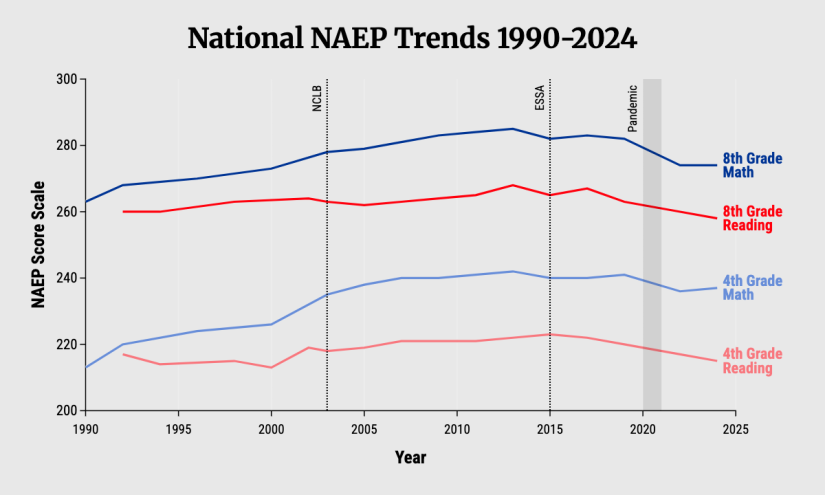
The United States entered a “learning recession” in 2013 that it has struggled mightily — and thus far ineffectively — to escape, according to a report unveiled Wednesday by a group of respected social scientists. A steep drop in student performance was already visible during the first Trump presidential term, with reading scores falling roughly as much before the pandemic as they did during its peak.
The disquieting findings come from the latest release of the Education Scorecard, a data project spearheaded by scholars at Dartmouth, Harvard, and Stanford. Rolled out in 2022, the collaborative initially aimed to chart how quickly schools bounced back from the disruption of remote learning. Now in its fifth year, the research team has turned their perspective backward in time to examine events leading up to the academic crash.
Harvard Economist Offers Gloomy Forecast on Reversing Pandemic Learning Loss
Among those developments, the newest dispatch devotes special attention to two: the rollback of school accountability policies that were the hallmark of the federal No Child Left Behind law, and the spread of social media to younger children. While acknowledging a lack of firm causal evidence, the authors argue that the parallel trends helped precipitate a downward spiral in student outcomes.
Thomas Kane (Harvard University)
Thomas Kane, a professor of economics at Harvard and one of the Scorecard’s creators, said that taking a longer perspective on student achievement illustrates not merely the enormity of the loss, but also the impressive progress that preceded it.
Results from the National Assessment of Educational Progress (a federal exam often referred to as the Nation’s Report Card) show that fourth- and eighth-graders steadily grew more proficient in core academic subjects from 1990 through 2015, absorbing the equivalent of two grade levels in math knowledge during that time. Kane said it was all the more frustrating to see those gains, which he stacked against the most important public policy successes of the last half-century, substantially unwound over the last decade.
“If you had told me in 1990 that we would see that kind of rise in fourth- and eighth-grade math, I’d have said you were crazy,” Kane reflected. “And yet it happened, and nobody celebrated.”
Morgan Polikoff (University of Southern California)
The post-pandemic era has seen a number of experts explore the beginnings of the K–12 downturn, which first became evident through NAEP data near the end of the Obama presidency. Those investigations have repeatedly established that learning losses started well before 2020, while shining less light on possible explanations. Morgan Polikoff, a professor of education at the University of Southern California, said the Scorecard was laudable in its ambition to “tell the whole story,” even in the absence of dispositive proof.
“This paper is, by far, the most comprehensive effort to explore the two main hypotheses for what’s gone wrong in education over the last decade-plus,” he said.
What remains uncertain is the path forward for schools and communities that have seen a generation of students learn less successfully than the one preceding it. Kane and his collaborators recommend a reorientation in federal research priorities to study the impact of social media use, as well as wide-ranging responses to the problem of chronic absenteeism. In the meantime, their release includes a set of local case studies showing where districts have led meaningful improvements in the last few years. Among them are a number of major urban school systems not historically numbered among the nation’s top performers, such as Atlanta, Birmingham, Alabama and Compton, California.
K-12 Chronic Absenteeism Rates Down From Peak, But Remain Persistently High
But the silver linings of the 2020s may be obscured by the grim chronicle of the 2010s.
Doug Lemov is a former teacher whose book, Teach Like a Champion, has become a reference text for educators around the world. Reviewing the report’s conclusions, he said he hoped it would help both the public and the education policy world reach a fuller understanding of the challenges converging in American classrooms — a long list encompassing technology and accountability policy, but also a broader collapse in the authority of schools, he added.
“All of these social changes have happened together, they’ve been disastrous for schools, and their effects tend to narrowly be blamed on ‘the pandemic,’” Lemov said. “But the causes are bigger.”
Graphic by The 74. Source: Education Scorecard
The end of NCLB
If part of that blame can be laid at the feet of the federal government, as Kane and his co-authors contend, it can be traced back to 2011.
That was the year when the Obama administration began issuing waivers to states to avoid penalties for failing to meet the conditions of the decade-old NLCB, which had boldly mandated that 100 percent of K–12 pupils attain proficiency in math and reading by the end of the 2013–14 school year.
While student performance in both subjects had moved steadily upward for years, no state could meet that timeline; NCLB’s ever-rising standards meant that roughly half of American schools fell short of their academic goals by 2011. In a bargain struck with Obama’s Department of Education, states could seek relief from federal accountability requirements if they agreed to adopt new academic standards, overhaul their teacher evaluation systems, and meet a few other requirements. In all, over 40 states had applied for and received the waivers.
As the Scorecard authors document, education leaders used their newly earned flexibility to ease off their scrutiny of the lowest-performing schools in their states; by 2014, under 10 percent of schools were flagged for missing learning benchmarks, a massive decline from just a few years earlier.
Graphic by The 74. Source: Education Scorecard
In consequence, not only were fewer teachers, principals and superintendents explicitly prodded to boost student learning — under NCLB, schools faced an escalating set of sanctions, including the prospect of permanent closure, for persistent ineffectiveness — public awareness of academic underperformance also fell dramatically. Through an archival search of major news outlets, the Scorecard researchers discovered that the annual number of media references to federal accountability categories and penalties fell by 97 percent after 2017. By that time, NCLB had been replaced entirely by the Every Student Succeeds Act, which ratcheted down expectations on states to an even greater extent.
Polikoff recalled that, prior to the changes of the 2010s, even his affluent home district in suburban Chicago was leery of federal interventions. But such communities were largely able to relax after being granted waivers.
“The waivers, and then ESSA, fundamentally changed the level of pressure and scrutiny on a big chunk of schools — in particular, these middle-to-high-performing schools that clearly know they’re not going to be at the bottom of the distribution.”
The second major factor identified in the paper is the rapid rise of social media use among school-aged children. According to recent surveys by the Pew Research Center, the portion of U.S. teenagers saying that they were online “almost constantly” jumped to 46 percent by 2022.
Study Links Increased Broadband Access to Suicide Risk Among Teens
While the effects of this shift are debated, a growing body of psychological research has pointed over the last few years to a link between internet use, social media saturation, and poor youth mental health. While stipulating that the connection cannot be assumed to be causal, Kane and his coauthors note that the students who posted the lowest scores on the international PISA exam were also the likeliest to report high social media use.
Laws restricting smartphone use inside of schools have spread rapidly in the past few years, though published studies have shown little corresponding signs of academic improvement. One widely cited paper, released earlier this month by Stanford professor Thomas Dee, delivered a split verdict: After two years of implementation, students forced to hand over their phones each day exhibited better psychological well-being, but their showing on state assessments was mostly unaffected.
David Figlio, an economist at the University of Rochester who conducted some of the earliest research into schoolwide bans, has found they yield modest academic benefits in their early stages. In an email, he wrote that he was unsurprised to see social media use specifically called out in the Scorecard report. But he also noted that most kids enjoy free access to digital technology outside the classroom.
Graphic by The 74. Source: Education Scorecard
“To the extent that reducing cellphone use will reduce classroom distraction, that seems like a good thing. But there are many ways for students to access these distractions even in the face of cellphone bans,” Figlio said. “Home use, with its attendant sleep disruption and crowding out of homework, study, etc., is certainly still present.”
‘Top national priority’
The few existing studies probing the correlation between student achievement and social media’s sudden ubiquity paint only a suggestive, if incomplete, picture, Kane conceded, adding that the broadening of that inquiry “ought to be a top national priority.”
That could be a job for a reconstituted Institute for Education Sciences, the Washington agency charged with supporting education research. About 90 percent of the IES workforce was terminated in the early months of the Trump presidency, but some re-staffing has taken place since. More recently, the Department of Education commissioned a blueprint for the rebuilding of its empirical arm, including a recommendation that federal officials narrow their focus to a set of key issues facing schools.
A Year After Deep Cuts, Can the Institute for Education Sciences Remake Itself?
Kane remarked that the phenomena identified in the latest Scorecard release would make an excellent start. University-based experts couldn’t summon the same resources or urgency as the U.S. government, he concluded.
“If you leave it up to the research community to come to consensus on the science of reading, or the effects of cellphone bans, or the effects of social media, you’re going to be waiting decades,” he said. “So somebody needs to be convening people, looking for conflicting findings, and trying to reconcile them.”
David Filglio (University of Rochester)
In the meantime, the report identified 108 districts that have posted sizable gains in both math and reading — and nearly 450 that have seen large improvements in at least one of the two subjects — since 2022. While some are listed among the most privileged school systems in the country, a number of large and relatively unsung urban districts have already returned to pre-COVID learning rates.
Among them is Washington, D.C., where reading achievement for students in grades 3–8 now exceeds the level set in 2018 by the equivalent of almost half of one grade level. A case study assembled by Kane and his colleagues identifies specific steps taken by the district’s leaders to bring about that progress, including the development of a proprietary K–5 English curriculum and the provision of stipends to teachers for undergoing specialized literacy training.
The Scorecard team recommends that education leaders deploy their own staff to rapidly improving districts to learn from their success. With time, they conclude, cities like Washington could become K–12 exemplars in the same way that Mississippi has set a template for states with its reading reforms.
Figlio said there was promise in the idea, but added a note of caution.
Doug Lemov (Edutopia)
“It’s hard to go to a school district, see that they are doing ten different things, and know which of these things is actually leading to the improvements,” he wrote. “By all means, we should study districts that seem to be beating the odds, but we need to make sure that the lessons learned are durable and transportable rather than anecdotes or circumstantial evidence.”
Lemov said that the most important lessons might be gleaned from years past. Since the reform era, he lamented, states have been all too happy to overlook poor results from their schools — and the schools themselves have been loath to set higher expectations for themselves or their students. The effects can be measured in lost learning opportunities, he said, but also teacher burnout from working in increasingly chaotic disciplinary environments.
“All of the things we did really well — only in unwinding them have we realized how much progress we were actually making. Which is tragic, but it suggests that we could wind them back up if we wanted to.”
Did you use this article in your work?
We’d love to hear how The 74’s reporting is helping educators, researchers, and policymakers. Tell us how
