

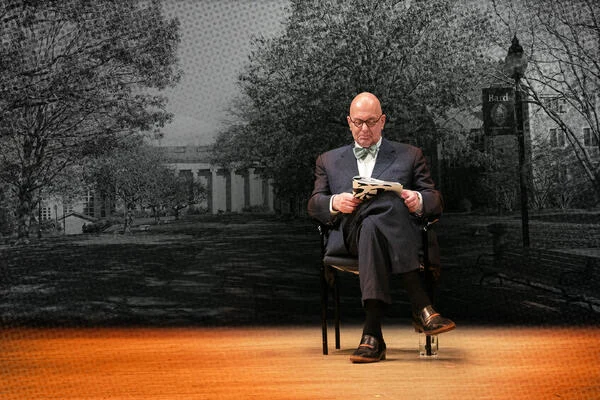
A tranche of files released by the Department of Justice in January revealed that Bard College president Leon Botstein’s conversations with the late convicted sex offender Jeffrey Epstein went beyond fundraising for the college. The two men had planned to purchase an expensive watch together and discussed Botstein visiting Epstein’s island. In response, the college opened a board investigation into Botstein’s ties to the financier, which wrapped late last month. A resulting two-page brief explained that the president did not commit any crimes but did minimize his relationship to Epstein.
Once the investigation ended, Botstein, soon to be 80, announced he will retire at the end of June after serving as president of the liberal arts college in Annandale-on-Hudson, N.Y., for 51 years. Over the past four months, Botstein has made few public statements and repeatedly declined or ignored requests for interviews from the media.
But over a Shabbat dinner at his home on Friday, Botstein addressed a range of topics with friends, family and any Bard students who chose to attend. In response to their questions, he talked about his upcoming retirement, the challenges and rewards of fundraising, his relationship to Epstein, the investigation, his opinion of the news media, and his lasting legacy at Bard.
Inside Higher Ed obtained a recording of the dinner conversation, which we’ve summarized and quoted here. In an emailed statement, vice president for student affairs Dumaine Williams said it was “disappointing that conversations at a religious gathering like a Shabbat dinner were recorded and shared in this manner. These gatherings have long been open to the Bard community in a spirit of trust, respect, and inclusion, which makes this event particularly unfortunate.”
Read on for Botstein’s thoughts …
… on retirement:
Botstein will retire on June 30 and move from the Gerry House, where he’s spent his presidency, into the Finberg House, a campus home built about 20 years ago for Botstein to live in during his retirement. The house was funded by former trustee Alan Finberg and his wife, Barbara. Botstein told dinner attendees that retirement was a “welcome” change after serving as a college president for 56 years, 51 of which he spent at Bard. He will remain on the faculty as a music professor after he steps down and stay involved with the Bard Music Festival, SummerScape and the Bard Conservatory.
“Instead of spending 20 percent of my time doing [music performance and scholarship], I’m going to spend 100 percent of my time doing that,” he said at the dinner. “So I’m not doing anything new. I’ll probably do a little bit more teaching on the music side than I’ve had time for and probably continue with the first-year seminar as well. So it’s less of a radical shift, and it’s a very welcome shift from my point of view.”
He repeatedly told guests that he would have retired earlier except that he wanted to wait until the college had built up a solid nest egg. The now $1 billion endowment is the result of a fundraising push that didn’t end until Jan. 1, he said.
“So that was the first time I could actually think about retiring, which is what I thought about doing, but it would not have been responsible for me to do that. So if you think I want to hold on to this job, believe me … I’ve been a college president without interruption, without a single vacation, for 56 years because I came here from having run an experimental college for five years before then that was bankrupt, completely bankrupt. And so [retirement] is very welcome, actually.”
One guest asked why he never sought a college presidency or other job beyond Bard.
“I’m from an immigrant family. I’m an immigrant myself and from a family that wandered from place to place. So I had no particular interest in moving around,” Botstein said. “And I always thought it was a loss of time, especially since I maintained an ambition as a scholar and a performer. The idea of moving into a new job—you lose time, [because] you learn the place, learn the people, and time is a precious commodity.”
… on Bard’s next president:
Asked how he might be involved in the presidential transition, Botstein said he will pass the torch and plans to “stay out of that person’s way.” He said he’d offer help if the new president wants it, but that he doesn’t want to be a “burden.”
… on fundraising:
If there’s one lasting legacy almost universally agreed upon, it’s Botstein’s fundraising prowess. Throughout his half-century tenure he raised between $2 and $3 billion for the college, he told guests.
In the early days, “We were … trying to break even every year and raising the money for all the scholarships and all the things we did year by year, and the [price tag] got too big to do that. So the only solution was an endowment, to try to raise an endowment, which took us a long time to do,” Botstein said. “The college has no history of traditional philanthropy. So most colleges … are funded by their alumni and, to some extent, parents. Of the money we’ve raised, I’ve raised, since I’ve been here … 80 percent of that comes from people who are not graduates and not family members.”
He spent a lot of time soliciting wealthy donors that would otherwise be unfamiliar with Bard College. During dinner, he didn’t sugarcoat the realities of courting the ultrawealthy.
“Fundraising is very ugly business, because the rich play by their own rules and they don’t have to behave the way the rest of us do. So they’re abusive, they’re rude, they’re stingy, they’re ungenerous, they expect to be kowtowed to,” he said. “And in all my years of fundraising, there are two really generous wealthy people whose ethics and character are completely admirable. That’s two out of hundreds. And then there’s a sliding scale.”
He did not mention the names of the two people he believes to be most generous and admirable.
During the investigation into his ties to Epstein, Botstein told investigators that he would “take money from Satan if it permitted me to do God’s work.’” He made a similar comment to guests on Friday.
“There’s no clean money. And so the question is that it isn’t where the money comes from or from whom the money comes, but what you use it for,” he said. “And so I would take money from the devil if it allowed me to support five refugees from Ukraine. Absolutely.”
… on Epstein:
Botstein first landed in hot water for associating with Epstein in 2023, when news surfaced that in 2016 Epstein’s foundation had given Botstein $150,000, which he later donated to Bard. He told dinner attendees on Friday that he had “no choice” but to pursue Epstein—who gave an unsolicited $75,000 gift and 66 laptops to the college in 2011—as a potential donor. He also reiterated that he was ultimately unsuccessful in hooking the multimillionaire.
“We were unsuccessful in raising money from Jeffrey Epstein. [Soliciting money from him] was a reasonable thing to do at the time. He was a [multimillionaire] who expressed interest in music and the arts and science, and we had no rule against soliciting money from ex-convicts. We have a prison program [with] hundreds and hundreds of ex-convicts. So, you know, we didn’t know much about him and he didn’t consume much time.”
He also maintained that he and Epstein were not friends—something he’s said repeatedly over the past several months—and called reporting on the connection “slanderous.”
“He was actually obnoxious and difficult to deal with. And spiteful and sadistic. He was not a nice guy. But there are many rich people who are not nice guys. So if I simply raised money from people who I thought were nice, I wouldn’t be able to pay a single salary,” he said.
Near the end of the conversation, Botstein expressed frustration at the attention paid to his interactions with Epstein instead of other ongoing political and social issues.
“I was amazed by the interest in [the Epstein controversy] as opposed to the interest in the real things that are going wrong now in the country … What’s happening today—everything from ICE, to the war in Iran, to the evisceration of budgets for education and science, to the destruction of the National Institutes of Health, to the lying and corruption that is centered in Washington—nobody seems to give a damn. But they give a damn about this?” he said. “I’ve never been accused of a crime. Never. And we have a justice system that presumes innocence. There’s no reason to doubt my innocence. My crime was … being associated with this person in search of money. And so this was the obsession. While you were—not you, but collectively you—obsessing about that, we were trying to get someone out of ICE detention. That’s what we were doing.”
Botstein was likely referring to Bard student Ali Sajad Faqirzada, who was detained by ICE during a required immigration appointment in October and held at Delaney Hall Detention Center in Newark, N.J., until he was released around early April.
Ultimately, Botstein said that “chasing this guy for money was not a mistake” and that his soliciting Epstein for donations will not impact the college as a whole. “With my retirement, the problem goes away,” he said.
… on the news media:
“Nothing sells newspapers like the name Jeffrey Epstein,” Botstein told his guests. “This is the most famous criminal of modern times, and so don’t think that newspapers are interested in the public welfare—they’re interested in their bottom line. And now with the internet it’s about clicks and about advertising, so they’ll [wring] every last penny out of the story.”
Botstein expressed his disdain for the media coverage of his ties to Epstein and said he “should have been given the benefit of the doubt” after 51 years in the Bard presidency. He repeatedly asserted that the strong media interest in his relationship to Epstein is driven by financial incentives.
“People love to moralize, and [it’s] much more popular for newspapers and for the internet to say bad things. Now, saying bad things about bad people is not interesting because you already know they’re bad. But saying bad things about people who you might presume to be nice is a delight. It sells. … So I somehow have become a minor revenue stream for the outlets that like to talk about it. This controversy hasn’t, I wouldn’t say, improved my view of human nature. I am of the belief that if you have nothing good to say about somebody, keep your mouth shut.”
Botstein also accused a local news outlet of practicing yellow journalism and said his trust in the media, including legacy newspapers like The New York Times, has only decreased over the years.
“I never liked journalists and never liked newspapers and I never trusted them. … and so it’s only gotten worse,” he said.
… on the independent investigation:
In public statements, Botstein repeatedly said he supported the board’s decision to bring in the Washington, D.C.-based law firm WilmerHale to investigate his communications and interactions with Epstein. But at Friday’s dinner, he called the investigation “very sloppy and very biased.”
“They tried to impugn my character, but they didn’t find any evidence of wrongdoing, illicit or immoral or illegal activity. And they didn’t even find some smoking gun of inappropriate conversation,” he said.
… on board chair Jim Cox Chambers’s departure:
Shortly after the board voted to end Botstein’s tenure in June, Chambers and two other board members resigned. Chambers’s decision “was expected,” Botstein said. “I think the board expected it. I think he was chairman for 10 years, and so his time was coming up.”
Board turnover always happens at the end of each year, he added.
“Jim is very smart, very original, and he’s not the most predictable person. And I’m surprised that he lasted as long as I think 10 years as chair. I expected him to stay five or six,” he said.
… on his legacy:
Botstein was only 29 when he became president at Bard. It took two years for the board to fill the role in the 1970s because “nobody wanted the job,” he said.
“The reason nobody wanted the job is the college had no endowment, was heavily in debt, hadn’t built a new academic building in 30 years and had 600 students and a declining applicant pool. It had a very distinguished intellectual history, mostly around literature and a little bit of the arts, but it was a down period for American colleges and the people who were offered the job turned it down,” he told guests.
But his youth was a strength—older candidates with families didn’t want to take on the uncertainty of Bard, he explained. “In my 20s, I had learned to tolerate risk.”
Botstein told several stories about his time and accomplishments at Bard. One of the first was about the creation of a Jewish community on campus.
“There was no Jewish infrastructure in the college when I arrived. There was no curriculum and there was no Jewish student organization. There was nothing,” Botstein said. “So the then-chairman of the board and I started it—gave the money and created the prayer space and all that. And so, then [we] built the … curriculum of Jewish history. I’m interested in keeping a protective eye on that by helping whoever succeeds, takes over, to keep that going. So I’ll be around.”
The job also came with less savory responsibilities, he said.
“You have to do this kind of work without the sense that someone’s going to give you a gold star for it. You know what I mean? … Much of the time you spend in this kind of job is dealing with people’s dissatisfaction, people complaining. That’s the overwhelming [part] … But you can’t resent it because that’s why you have the job,” Botstein said. “And there are many happy moments of things that went well and things one could be proud of—things done by students, by faculty members. Hiring very good people was among the more enjoyable parts of the job.”
He continuously looked back on his tenure fondly.
“I have no complaints,” Botstein said. “I was privileged to be able to do this work.”
