

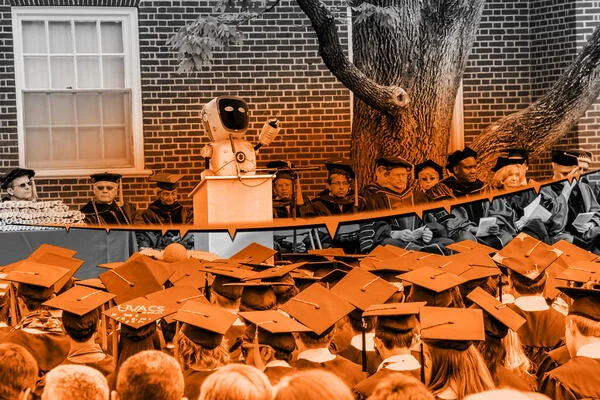
Nearly one-third of colleges students feel “nervous” or “anxious” about AI’s impact on their future career.
Photo illustration by Justin Morrison/Inside Higher Ed | ablokhin and PhonlamaiPhoto/iStock/Getty Images
College students may use AI-powered tools almost daily, but their anxiety and anger over the technology’s swift intrusion into their lives is taking center stage this graduation season.
At the University of Central Florida’s commencement ceremony in Orlando earlier this month, students cheered when the featured speaker—investment executive Gloria Caulfield—reminded them that “Only a few years ago, AI was not a factor in our lives.” But those cheers quickly devolved into boos when she declared that “the rise of artificial intelligence is the next industrial revolution.”
Last weekend, a similar scene unfolded at the University of Arizona in Tucson when Eric Schmidt, former CEO of Google, told some 10,000 new college graduates that he sympathized with their fears that “the machines are coming, the jobs are evaporating, that the climate is breaking, that politics are fractured”—but they must adapt to an AI-powered world nevertheless. “The question is not whether AI will shape the world. It will,” Schmidt said as the audience jeered. “The question is whether you will have shaped artificial intelligence.”
And just two hours north at Glendale Community College outside Phoenix, students voiced their disappointment and frustration after an AI-powered system that was supposed to announce the graduates as they walked across the stage mixed up or skipped hundreds of their names.
But the Class of 2026’s hostile reactions to AI aren’t happening in a vacuum. The AI-related outbursts at graduation ceremonies this month embody a deeper, generational resentment over coming of age in a decade marked by strained human interactions and a volatile economy, said J. Israel Balderas, a lawyer and assistant professor of journalism at Elon University whose work focuses on free speech and AI.
“These reactions may seem emotional and disproportionate on the surface, but AI arrived at a moment when many of these young people were already questioning how technology has shaped their relationships, their attention spans, their mental health and even their sense of belonging,” he told Inside Higher Ed. “Add AI disruption to that, and there’s a growing sense among young people that they are inheriting systems that they didn’t design and they don’t fully control.”
A Complicated Relationship
When this year’s cohort of college graduates arrived on campus in fall 2022, they had already spent half of their high school years coping with the isolation and uncertainty of the COVID-19 pandemic. Then, as soon as the pandemic began to fade, tech companies launched a litany of generative AI products—and followed up with predictions that such tools will soon wipe out large shares of entry-level white collar jobs. In response, scores of colleges and universities have since invested big money to partner with tech companies—including OpenAI, Anthropic and Google—to integrate AI tools into campus operations and coursework in the name of preparing an AI-literate workforce of tomorrow.
AI’s inevitability was also the message Scott Borchetta, CEO of Big Machine Records, shared with the graduates of Middle Tennessee State University during his May 9 commencement speech.
“Streaming rewrote the economics, social media rewrote the discovery model, AI is rewriting production as we sit here,” he said as the crowd booed in response. “Deal with it. Like I said, it’s a tool … You can hear me now or you can pay me later.”
Despite the acrimony some college students hurled at Borchetta and other AI advocates who spoke at graduation ceremonies this year, data shows that students have developed a complicated relationship with AI.
According to Inside Higher Ed’s 2025 Student Voice Survey, 85 percent of college students said they use generative AI to help with their coursework, including using it to brainstorm, study or even generate entire research papers. But while generative, and now agentic, AI may be making it easier for students to pass their classes—and cheat outright if they are so bold—it’s also stoking fears about their postgraduation futures.
“Students are using AI, but they also don’t trust it,” Balderas said. “As students are graduating, talking about AI and the future of work or creativity is hitting a nerve. They are gripped by fear.”
In the three-plus years since generative AI went mainstream, majors that once seemed like safe bets for well-paying careers have been shaken by the technology. Between 2022 and 2025, employment for early-career workers in “AI-exposed” fields—such as software development—dropped 16 percent compared to employment for more experienced workers in those roles. At the same time, the unemployment rate for recent college graduates hit 5.6 percent at the end of last year, compared to 4.2 percent for all workers.
Those realities, combined with the continued rise in the cost of living, are making it hard for many college students to embrace the idea of an AI-laden future with the kind of enthusiasm displayed by this year’s crop of wealthy, older commencement speakers.
According to a recent poll from the education consulting group EAB, half of students feel “uncertain” about AI’s impact on their careers, 10 percent feel “depressed,” 32 percent feel “concerned” and 31 percent said they feel “nervous” or “anxious.” Meanwhile, just 7 percent said they feel “excited” and 13 percent “optimistic.”
‘Deeper Fear’
But the malcontent over AI that students expressed at commencement ceremonies this year extends beyond anxiety over losing out in the job market.
“When AI starts appearing in spaces that have traditionally carried emotional meaning—like graduation ceremonies—the reaction is going to be bigger than the specific incident itself,” Balderas said, adding that he wasn’t surprised by student reactions to some of the AI-focused commencement speeches. “This is tapping into a deeper fear that society is becoming very good at simulating human interaction while becoming worse at actually practicing it.”
But not every graduation speaker who dared to mention AI has generated such vitriol. At Loyola Marymount University in Los Angeles, students applauded Ben Sherwood, CEO and publisher of The Daily Beast, for defending the human experience as inimitable and precious.
“You are graduating into a world transformed by AI. Machines can now prepare essays, codes, images, music, fear, strategy, human conversation,” Sherwood told graduates. “But there is one thing they cannot do. They cannot live a human life. Machines generate answers. You get to live your way into one.”
