

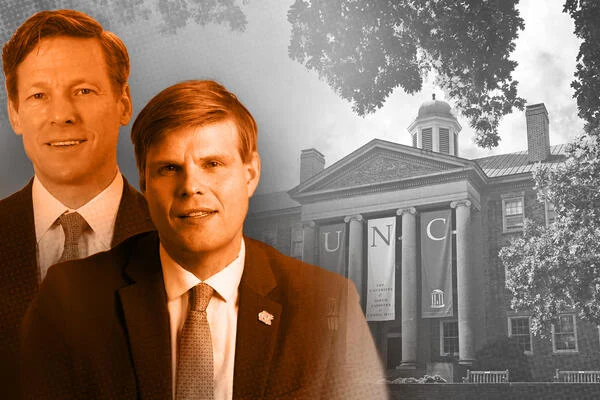
The University of North Carolina at Chapel Hill’s civics school has been controversial since early 2023, when the campus Board of Trustees called to “accelerate” its development before faculty even knew it was underway. The board’s then-chairman said on Fox News he was trying to “remedy” a lack of “right-of-center views” on campus.
Other campuses in GOP-controlled states have seen discord over efforts to establish similar, apparently conservative-leaning, schools, with faculty battling the university leaders and Republican legislators who circumvent them to build the centers. But things got muddier at Chapel Hill, blurring a simple characterization of left-leaning faculty versus the right. Conservative faculty who initially helped create the Chapel Hill School of Civic Life and Leadership (SCiLL)—including then-provost Chris Clemens—began fighting with the school’s dean, Jed Atkins, over the hiring process.
The university said it selected the international law firm K&L Gates last summer to review “allegations and concerns” regarding the school. Over more than seven months, the review team analyzed hundreds of thousands of documents and interviewed dozens of people.
The report is complete, reportedly at a cost of $1.2 million and running more than 400 pages. But the university is refusing to release any of it—despite calls from students, faculty and media to at least reveal some contents. Chapel Hill is now also facing a lawsuit over its refusal to provide more information.
While the university hasn’t released the report, it did release statements backing Atkins after the report was finished.
“Launching a new school at a leading public research university is an ambitious undertaking under any circumstances,” Chapel Hill chancellor Lee Roberts wrote in one of the statements. “Doing so amid scrutiny and intense public attention requires resilience, focus, and resolve. Dean Jed Atkins has demonstrated that resolve. He has continued to build SCiLL’s academic foundation, recruit faculty, and advance meaningful programs including the development of new graduate offerings and the securing of a $10 million grant from the National Endowment for the Humanities.”
University Media Relations told Inside Higher Ed in an email Wednesday that it stands behind its statement from before the investigation began: “SCiLL’s faculty searches honored all university rules and procedures.”
Last month, when asked at a campus Faculty Council meeting why he couldn’t release the report, Roberts said it’s “all personnel information; it’s subject to attorney-client privilege.” He added that legal counsel had told the university, “You can’t release this, it’s protected personnel information.” But Roberts later said, “The university can always waive the privilege.”
Deputy general counsel Kara E. Simmons further told the council that the report contains perspectives many faculty shared in confidence with the review team, adding that the university wants faculty to know they will receive appropriate privacy in any future investigations.
The university said it offered Faculty Council chair Beth Moracco and council secretary Joy J. Renner the right to read the report if they signed confidentiality agreements, but they declined. Moracco told Inside Higher Ed she “did not see the utility of that because I wouldn’t be able to fulfill the desires of my constituency”—namely, the faculty, who want to know the findings.
Maxine Eichner, Graham Kenan Distinguished Professor of Law at Chapel Hill, told Inside Higher Ed that university leaders’ given reasons for not releasing the report “have varied a little bit over time.” But she said the university’s offers to let Moracco and Renner read it suggest officials can release at least parts of the document; if it’s all confidential personnel file information, the university wouldn’t have had the privilege to waive that confidentiality, Eichner said.
“The university is certainly not acting like this information is confidential personnel file information,” she said.
Media Sue
The details about the report’s length and cost are listed in a lawsuit filed earlier this month by a group of North Carolina media outlets. They’re asking a judge to review the report and order as much of it released as the law demands.
The media lawyers argue the report is a public record under state law because it “was made at the request of and on behalf of the University, was paid for by the University out of public funds, and was received by the University.”
Yet university leaders have refused to release any part of the report, the lawyers wrote in the suit, or “even to identify any of the persons interviewed by K&L Gates, any of the specific allegations or concerns addressed by the investigation, any of the findings or determinations resulting from the investigation, or any corrective or other actions taken.” The Assembly and News & Observer even narrowed their requests to an executive summary of the report and were shot down, the suit says.
In response to the suit, Chapel Hill general counsel Paul Newton said in a statement that “as a public university we take seriously our responsibility to consistently and completely respond to public records requests in good faith, in a timely manner, and in accordance with the law. The public records act contains several thoughtful exceptions that protect the private personnel information of our faculty, students and administration. The law also acknowledges the attorney client and attorney work product privileges.”
Chapel Hill does have one fewer lawsuit to deal with: This month, Clemens, the former provost, dropped the suit he filed in September against Board of Trustees members. The suit included allegations against Atkins.
A judge had dismissed some of Clemens’s legal claims before he dropped his case. He told Inside Higher Ed, “The reason that I withdrew my lawsuit is I was satisfied with the changes in the board.” John Preyer, who helped establish SCiLL, resigned from the board in January.
Last Friday, the Chapel Hill Faculty Council passed two resolutions regarding SCiLL. The first, which Moracco said passed unanimously, asks the university to clarify the “established criteria and protocol, if any, for creating new schools within the University.” It also asks the university to clarify what role shared governance plays in that process and whether new schools are subject to existing policies on curriculum approval and faculty appointment, promotion and tenure.
The second resolution—which Moracco said had three no votes and one abstention (the Faculty Council’s site lists 94 voting members, but it’s unclear how many attended)—calls for Roberts to release the investigative report after redacting “any confidential personnel information legally prohibited from being produced and any identifying information of persons interviewed.” It also calls for Roberts to share his plans to “remedy any irregularities of SC[i]LL’s establishment, hiring practices, and the actions of its dean, in order to move forward with the transparency that the faculty, University community, and the public deserve, and to lift the cloud these allegations cast on the legitimacy of SC[i]LL and the excellence of our University.”
Moracco called it “unsatisfying” and “frustrating” to be denied information on what the report found or even on the underlying allegations that were investigated. She said well-respected faculty had alleged hiring irregularities and other issues, and noted there was “an exodus of faculty who had originally been engaged with” the school.
On Friday, the TransparUNCy student activist group is holding a “Release the SCiLL Files” rally on the campus quad. Emma Serrano, a TransparUNCy organizer and Chapel Hill senior, said the group is also urging students to boycott SCiLL classes.
“We believe it was organized on fraudulent grounds and it’s a Trojan horse for a reactionary right-wing agenda,” Serrano said. Pointing to the report’s cost and how long it took to complete, she said the university has a responsibility to release it.
Atkins, SCiLL’s dean, didn’t return a request for comment Wednesday. One of his supporters, SCiLL professor Dustin Sebell, has publicly called for the report’s release because he believes it will exculpate Atkins.
Sebell didn’t return Inside Higher Ed’s requests for comment, but he told The News & Observer in a statement that “the administration now knows that the dean of SCiLL did nothing wrong, and that faculty administrators, working to undermine the school and the legislative mandate, committed serious misconduct. By refusing either to publicly vindicate the dean or to hold anyone accountable, UNC leadership is exacerbating the damage already done.”
