

Your child has been admitted. Your child has committed to a school and reserved their slot. It’s time for the next big step: figuring out housing. For the purpose of this column, we’ll assume they’re going to a four-year institution with on-campus housing required at least in the first year.
As always, my most important advice is to get organized and learn as much from the school website as possible. It’s more complicated than you remember and colleges and universities tackle this issue very differently.
When I was growing up, a short stroll from the Middlebury College campus, housing for incoming first-year students there was simple: They lived with a roommate of the same sex in a double room with cinder-block walls and a single-gender bathroom down the hall. They were all “freshman dorms.”
By the time I got to college, things were modestly more complicated. My school offered a single, a double, a same-sex suite with two doubles and a bathroom on a co-ed hallway, or a double in a suite with older students. Just one of four dorm options was strictly for first years.
I was assigned a roommate based on a short lifestyle questionnaire (we’ll talk more about those in a second). I could have picked who I lived with but opted for the school to pick for me.
My son’s school pointedly does not let incoming students pick their roommate. “Meeting and living with people who have traveled a different life journey to arrive at [School] and who share different perspectives is key to the [School] residential life experience,” it says.
His lifestyle questionnaire asked him to self-identify from a list of two dozen gender identities, asked about when he gets up, when he goes to bed, whether he’d be comfortable with a trans roommate or one with a comfort animal. Substance-free housing was an option, as were some accommodations for kids with certain medical conditions.
Here’s a quick guide to what you and your child can expect.
The Lifestyle Questionnaire
This is still a typical tool.
Your child will get questions like the ones I listed above. But you might also see questions about hobbies, cleanliness level, as well as drug and alcohol use. Parents: Encourage your child to be honest. It’s OK to ask them what they plan to put for cleanliness – they will almost certainly assess themselves as cleaner than they are – but don’t hover as they fill this out.
Here’s what Bluffton University tells incoming students about the questionnaire: “Be honest when filling out this form. Don’t answer with Mom looking over your shoulder, pressuring the answers she expects. You will be the one living with the person chosen based on these answers.”
Get the admissions edge with ‘Getting In’!
Have the parent playbook for applying to college delivered to your inbox each Thursday.
By clicking “Sign Up”, you will receive the latest updates, including emails, from U.S. News & World Report and our trusted partners and sponsors, and you agree to our Terms and Conditions & Privacy Policy.
Random vs. Picked
Those answers will help schools that assign roommates determine a baseline of compatibility.
Some institutions let incoming students pick their roommate or opt to have the school choose for them.
“Often, students who did not know each other before can become great roommates and friends,” the University of Maryland tells incoming students.
Obviously, the questionnaire is less important if your child and a friend have already decided to room together.
The Search Is On
That could be a friend they’ve known from high school. But there are now countless ways to find a compatible roommate.
Some schools encourage the use of class groups on Instagram or Facebook, letting the kids find each other after checking out their profiles and chatting online. Admitted student events can also be good icebreakers.
But there are now third-party apps that handle the lifestyle questionnaire, enable chats, and help match your child with potential roommates. If that sounds vaguely like a dating app, you’re right. But this is potentially a yearlong commitment, not a coffee date. Check out Bunky or RoomSync.
Go Online
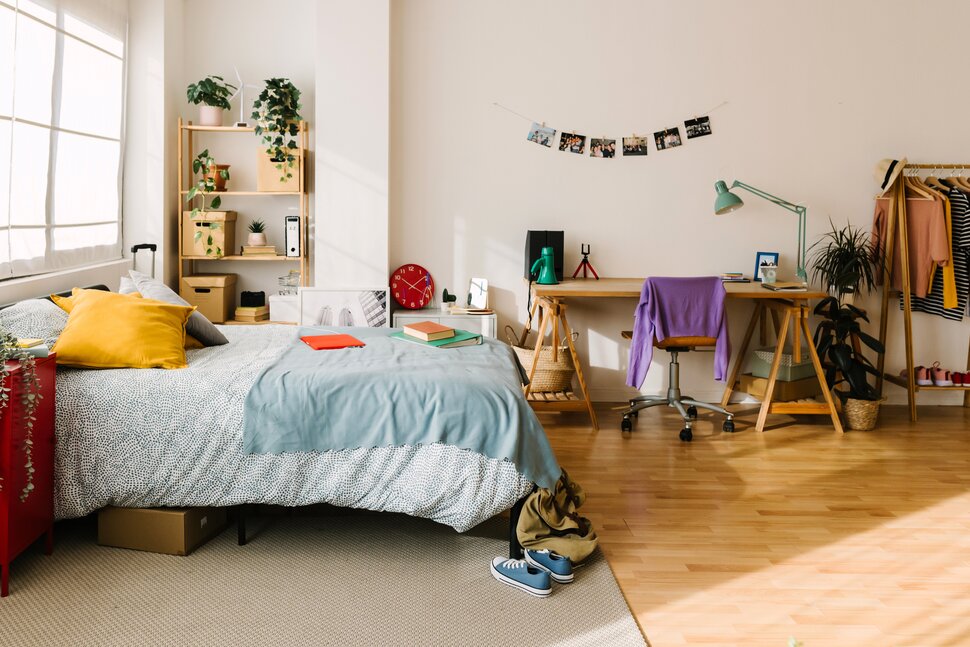
While the first year double hasn’t changed much – twin bed, desk, closet or armoire and dresser was still standard when we toured schools two years ago – your child should go online to look at what kinds of dorms are available to pick from.
Where on campus do they want to live? Are there trade-offs (the newest and nicest dorm might be farther from the dining hall, some dorms have elevators, some have A/C, etc.)? Do they want an all first-year dorm or a mix with older students? How do they feel about a bathroom down the hall vs. one in a suite?
Fun fact: You can read the official description of a given dorm. But you’re just a well-worded YouTube search away from a student-made video that takes you behind the scenes and shows what it’s really like.
Help them puzzle it out. But don’t make the decision for them.
