

BALTIMORE—As policymakers ramp up their scrutiny of higher education, the job of a university president is evolving—and perhaps more difficult than ever.
While college presidents are accustomed to “hat-switching” in service of a diverse constituency—including students, faculty, staff, alumni and legislators—“the real change” over the past five years has been “the ultra-politicization of the presidency,” Elaine Maimon, a higher education columnist and former president of Governors State University, said Wednesday at the 79th Education Writers Association National Seminar here. “It’s become such a [source of conflict] that it makes the president’s job especially hard.”
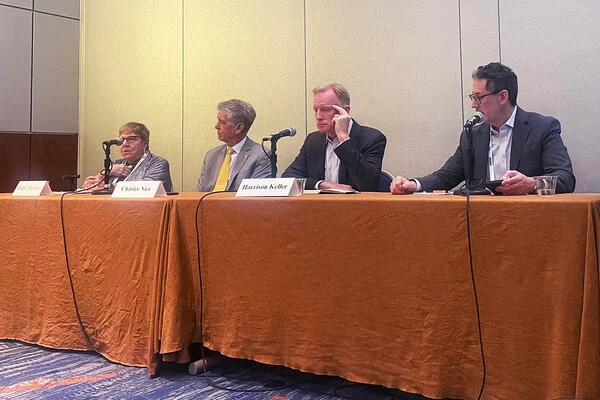
The panel, titled Many Hats and Increasing Pressure: College Leaders Discuss Their Evolving Roles, featured Maimon; Harrison Keller, president of the University of North Texas; and Charles Nies, president of the University of Minnesota at Duluth.
Over the past several years, college and university leaders have increasingly become targets of conservative policymakers pushing for more control over curricula and campus operations.
Numerous university presidents—including those from Harvard, Columbia and Northwestern Universities—have testified to Congress about their approach to combating antisemitism on campus, and several resigned soon after. Since President Donald Trump started his second term last year, the federal government has launched numerous investigations into universities over diversity, equity and inclusion efforts and frozen or terminated billions in federal research grant funding that college and university budgets across the country rely on.
At the same time, those running public universities in states such as Florida and Texas are also contending with ongoing efforts by state officials—who have accused universities of indoctrinating students with liberal viewpoints—to dictate what faculty can and can’t be taught.
But Keller, whose institution, UNT, is under fire from the state attorney general’s office for allegedly teaching verboten DEI concepts, said during the panel that he’s “less worried about indoctrination” and “more worried about whether we’re visibly and tangibly committed to having a kind of educational environment where people can say controversial things, disagree respectfully and debate, they can dialogue together.”
And if universities want to find innovative ways to adapt to the current political and social environment—which has also become more focused on proving the value of a college education—supporting faculty is crucial, he said.
“There’s this mythology, especially right now, that faculty, in particular, are not willing to change, or that faculty are resistant to innovation. I think that’s mostly false,” he said, adding that outdated course structures “don’t do a very good job of supporting the faculty and contributing to the kind of innovation that needs to happen within the institution.”
Instead, he said, universities should equip faculty with the resources they need to help students understand how the skills they learn in the classroom can help them succeed in the job market. “My impression is that most university administrators have not invested” in those partnerships with faculty, Keller said. “That’s to the detriment [of universities] because they’re incredibly, incredibly creative.”
Presidents are also under pressure to get creative about helping students find new funding sources, especially as new federal regulations have placed limits on graduate student loans, said Nies, president of the University of Minnesota at Duluth.
“We’re trying to figure out how to communicate that while there might not be the federal funding, [nursing and pharmacy, for example] are still good career pathways and the workforce need is out there,” he said. “Financial aid has always been one of those areas that feels like we’ve used our own language and have great confusion about what’s available.”
This new regulatory era, however, is pushing universities to talk about “the total cost of attendance and the other resources that we’re able to bring to bear in that conversation to make education affordable,” he said.
