

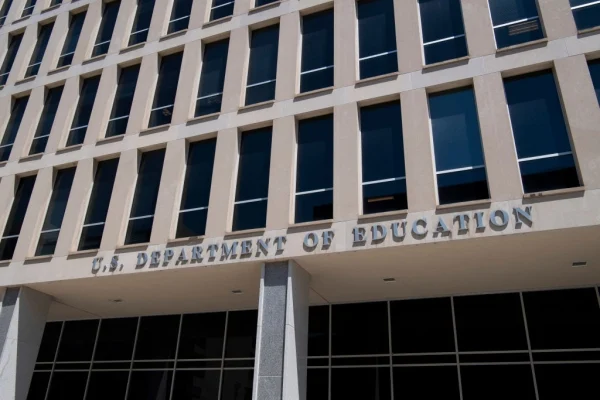
When the first week of accreditation rule making began last Monday, Education Under Secretary Nicholas Kent made one thing clear—he and his staff were firmly committed to “implementing bold reform.”
“We are open to new ideas,” the under secretary said, but, “to those who say the changes we are pursuing would upend higher education, I say, ‘Yes, that is the point.’”
Now that the first of two weeklong sessions is over, many higher education policy analysts and legal experts say Kent’s opening remarks set the course for the discussions that followed. Some observers say the department’s proposals are nebulous and could be abused not only by the Trump administration and Republicans but future Democratic officials, detrimentally turning accreditation policies and federal student aid access into a game of political Ping-Pong. But department officials largely dismissed those concerns, they say.
The first four days of the Accreditation, Innovation and Modernization committee meeting were largely spent walking through the department’s dense 151-page proposal.
Committee members representing employers, taxpayers and state officials largely applauded the department’s decisions. Meanwhile, individuals representing students, colleges, accreditors and the department’s accreditation advisory board raised several concerns, one of the most prominent being that many of ED’s provisions defied federal law.
Other areas of apprehension for members representing the sector included the shift away from a peer-review model in an effort to avoid alleged conflicts of interest, more detailed guidance on the standards that should be used when evaluating colleges and the extra emphasis placed on how accreditors should enforce First Amendment and civil rights law.
By Friday, the department had made some changes in an effort to address these concerns, but they appear to be largely structural, not substantive.
For example, a number of committee members said the proposed changes outlining how accreditors should evaluate their institutions are a demonstration of executive overreach.
Historically the regulations said agencies “must set forth clear expectations for the institutions or programs it accredits” in categories such as “student achievement,” faculty” and “student support services.” But in its new proposal, the department expands on those regulations by adding wording such as “standards should require that academic freedom protections must be clearly articulated and applied consistently to faculty” regardless of “race or other immutable characteristics, viewpoint, or ideology.”
Doing so, some committee members argued, threatens institutional autonomy and violates the Higher Education Act.
In response to committee members’ concerns, the department moved those details to a different section of the regulations, but the wording was not amended. One of the most vocal committee members—Jennifer Blum, a Republican-appointed member of the department’s accreditation advisory committee—underscored the lack of change.
“I do want to be on record, just for the benefit of the public, to know that this actually is not what we proposed,” Blum said. “I appreciate the department tackling the structure, but they did not take a fair bit of the changes that we had suggested.”
As various proposals were challenged, Jeff Andrade, the department’s negotiator and deputy assistant secretary for postsecondary education policy, stressed that the reforms are well within the department’s statutory authority and necessary to promote innovation and prevent a monopolized accreditation market.
“You went a bit far on that one,” Andrade told Blum when she questioned a proposal Thursday that would allow the department to override an accreditor’s actions. “I think [you’re] trying to insinuate that we would use this arbitrarily, or willy-nilly for anything other than protecting students … We are not going to use this arbitrarily. We are not going to use this to overturn an agency decision.”
The Risk of Political Influence
But policy experts say that regardless of who is in office, it’s less about what an administration says it intends to do—or not do—and more about what the regulations allow. And here, the policies’ unclear language could open accreditation and the federal student aid system up to political influence by any administration.
“Very valid concerns are being raised repeatedly by a really disparate group of people,” said Emily Merolli, a founding partner at Sligo Law Group. “And those concerns are being addressed by [ED] just saying, ‘Trust us. When you’re looking at this language it doesn’t mean what you’re reading it to mean. It means what we’re saying it means.’”
Jon Fansmith, senior vice president for government relations at the American Council on Education, noted that at the end of week one of negotiations, the department’s proposals hadn’t substantially changed.
“Starting the negotiations by having a political appointee tell the committee that the outcome is predetermined and that their views will be ignored unless they agree with the department says everything you need to know about how they’re ignoring both the spirit and the letter of the law,” Fansmith said. “Add in their other actions, like excluding major stakeholders from primary roles, and it’s clear the department never intended to solicit, much less incorporate, the concerns of the public, students, accreditors or schools in pushing their politicized agenda.”
(During his opening comments Monday, Andrade made a jab at ACE, the leading advocacy group for institutions, saying accreditation is entrenched by entities that want to preserve the status quo. “We aren’t going to solve this by listening to ACE” or other associations, lobbyists and think tanks that benefit from the current policies, he said.)
‘Something Needs to Change’
But other policy experts were more open to the Trump administration’s proposals and their goal of disrupting the current system.
Michael Duffey, chancellor of the Ohio Department of Higher Education and a committee member representing state officials, dismissed claims that the proposed regulations are an example of executive overreach or violate the Higher Education Act.
“[The department] did not propose a minimum graduation rate, for example, although many Americans probably (and rightfully if they do) expect one,” Duffey said. “It is, however, saying that the accreditors should have standards. Everyone should agree on standards. It is so obviously necessary. This is what the American public expects and what the law says.”
The fact that some institutions can have graduation rates as low as 10 percent but still maintain access to federal aid is frustrating, he added. Students and taxpayers have had enough and something needs to change.
Duffey also disagreed with critics’ claims that the department’s provisions requiring accreditors to ensure intellectual diversity on campus or compliance with civil rights law are beyond the bounds of its authority.
“It isn’t fair to claim the department is requiring accreditors to enforce ‘Trump’s interpretation’ of civil rights,” he explained. “That may be what left-of-center groups think is happening, but the actual language—which is what we’re reviewing—simply says follow the law.”
A source familiar with the rule-making meetings who spoke on the condition of anonymity believes some of the concerns raised are “political theater” as much as they are substantive, and generalizations that the department is trying to overly regulate are “completely unfounded.”
“There’s a clear sense that change is likely to happen here, but lots of folks would prefer it didn’t. Some believe the system works as it is, while others have figured out how to make it work for themselves and their interests,” they said.
From the source’s perspective, the department must provide stronger guidance in the new regulations to respond to “urgent gaps in the system” that current laws on accreditation do not yet fully address. They cited the growth of online education as a similar moment when accreditors and the department had to handle regulations before Congress modified statutes.
Others may think the Trump administration has gone too far, but it’s up to the negotiating committee to find the right balance. The question now is if it will reach consensus by the end of the second week of negotiations, beginning May 18.
“I would not even want to begin to figure out the likelihood of consensus,” said Merolli from Sligo. “This is always the tricky part with negotiated rule making. There are a lot of really promising ideas in here—things about transferability of credit and student outcomes. Yet, there are also a lot of different areas that are giving people pause.”
