

States play a central role in financing higher education through direct institutional support and student financial aid. While the federal Pell Grant remains the cornerstone of aid for low‑income students, its “purchasing power” has eroded, failing to keep up with inflation and covering a smaller share of posted total cost of attendance over the past two decades. State grants increasingly fill this gap. About a fifth of college students receive state aid. In 2023-24, undergraduate students received, on average, $1,280 in support from state grants, up nearly 40% from a decade earlier.1
Because states independently set higher education priorities, financial aid systems vary widely. After decades of state investment and amid a shifted national higher education landscape, this moment offers an opportunity to assess what these policies reveal about supporting college access and completion.
To that end, we reviewed research on state financial aid, focusing on the growing area of statewide promise or “free college” programs. In the first part of this report, we highlight data and analysis on state financial aid spending broadly. Then, we summarize research on promise programs and discuss how aid affects student outcomes, identify design features associated with stronger impacts, and highlight policy considerations that can inform the next generation of state financial aid programs.
Throughout this piece, we were informed by commentary, guidance, and evidence from a small series of roundtables that we conducted with research experts in the field of financial aid. In these roundtables, we asked our experts to help us contextualize emerging research, compare evidence across states, and identify priorities for policy design and future research. Researchers surfaced areas of consensus as well as highlighted unresolved questions, helping to clarify what we know and where ongoing work can be most valuable.
State higher education spending
States spent $134 billion on higher education in fiscal year 2025 with $16.8 billion (around 11%) going toward student financial aid—a share that has been slightly increasing over time. For context, the federal government is projected to spend $38.1 billion on Pell Grants in the 2025–26 academic year, alongside much smaller aid investments in Federal Work Study ($1.23 billion) and the Federal Supplemental Educational Opportunity Grant ($910 million). About 11% of undergraduate students’ grant aid comes from states, compared to 34% from federal sources and 46% from institutions (though some of public institutions’ support also comes indirectly from state appropriations to the institutions). These shares vary by sector. At public two‑year colleges, most grant aid comes from federal (63%) and state (26%) sources, while at many private nonprofit institutions, institutions provide 80%-90% of aid. In short, state aid represents a meaningful, but more limited, component of total grant support and functions as a complement to larger federal investments.
How states spend their aid dollars
States vary widely in their allocation choices, such as whether to allocate more toward direct grant aid for students or toward institutional support (which in turn affects the costs students pay). Several states spend relatively little on grant aid per full‑time‑equivalent (FTE) student, under $400 per pupil, while others spend substantially more, exceeding $3,000 per student in New Mexico and roughly $2,000 in Tennessee and Georgia. Higher per‑FTE spending often reflects the presence of broad, statewide financial aid programs, whereas lower average per-student spending is more common in states with narrower, income‑targeted aid. States that spend more per pupil on grant aid are also spending proportionately less on direct institution support (around 80%) compared to those states with lower per-pupil grant spending that instead send upwards of 95% of state funding directly to institutions.
We also highlight that a small number of states supplement higher education funding with lottery revenues. Where used, lottery funds often account for a significant share of total state support. In 2024, 10 states relied on $2.75 billion in lottery revenues to support 45 aid programs serving roughly 1 million recipients (though this figure likely overstates unique students because some receive multiple lottery‑funded awards). Lottery funding, however, may be an increasingly unstable revenue source, as recent declines in Tennessee and Missouri demonstrate.
In the map above, we highlight variation in state financial aid spending using the National Association of State Student Grant and Aid Programs (NASSGAP) 2023-2024 annual survey report. States are color-coded based on grant dollars awarded per undergraduate student FTE, and hovering over a state shows more details about total grant aid and expenditures, proportion of aid spent on need and merit, and a summary of whether the state uses lottery dollars to fund programs.
Over the past 15 years, states have spent a smaller share of their financial aid dollars on solely need-based programs relative to programs with a merit requirement. In 2023-24, states spent an average of 74% of their grant dollars on need-based programs. Some states such as New Mexico, South Dakota, Georgia, and Arkansas spend 5% or less of their grant aid on need-based programs. Georgia is in the process of establishing its first need-based statewide scholarship program. Some states may spend less on need-based aid because they use other policy levers to keep tuition and fees low; for example, Florida has the lowest sticker prices in the country and therefore spends less on aid, and the New Mexico Opportunity Scholarship supports tuition-free college at all New Mexico public colleges and universities without considering need, serving more students.
Using the recently released Beginning Postsecondary Students (BPS) 20/22 survey data on students who began college in 2019-20, we find that 29% of students receive state grants, 45% receive federal grants, and 35% receive institutional grants. Figure 2 shows the percentage of students who receive each type of grant aid by income quartiles (quartiles calculated separately for dependent and independent students).
There is a clear income relationship for federal aid: 82% of low-income students receive federal grants compared to 7% of higher-income students.2 Federal aid is based almost entirely on students’ need. State aid receipt also declines as income increases, but less dramatically, with 40% of low-income students receiving state aid compared to 12% of high-income students. State grants have a broader purpose, using both need and merit criteria to award grant dollars. There is little difference in the share of students receiving institutional aid across income groupings. This is partially how financial aid offices stack different aid sources. Typically, aid offices first apply federal and then state grants. Therefore, at lower-cost institutions, low-income students may have their tuition fully covered before the institution needs to step in. The lack of a strong income gradient for institutional aid is also because many colleges use partial scholarships to attract higher-income students who can pay higher tuition and subsidize financial aid for lower-income students.
Free college: Policy adoption
Over the past decade, several presidential campaigns and legislative proposals have called for a national free college program, but no federal policy has been enacted. However, many students experience free college through existing programs at the state, local, and institutional levels.
At the college level, free tuition programs promise enough aid to fully cover lower-income students’ costs (and sometimes middle-income students’ tuitions). The Washington Post recently compiled a list of about 1,000 institutions that offer some form of a free college guarantee. Of note, such programs are heavily reliant on low-income students also receiving federal and state grants to limit institutional costs.
At the state and local levels “promise programs” cover tuition and fees for students within a defined geographic area. Experts estimate that more than 200 state and local promise programs operate nationwide. State‑level promise programs have grown particularly quickly, though adoption has followed diverse paths. Between 2014 and 2019, 16 states introduced new programs, with another wave of states investing in free college during the COVID-19 pandemic that have now matured into permanent programs.
Who experiences ‘free college’?
Figure 3 shows that nationwide, about a third of first-year college students pay no tuition at all. Even more low- and low-middle-income students are enrolling tuition free: 58% and 41%, respectively.
But these figures drop precipitously when we consider the whole cost of postsecondary attendance—such as housing, food, and books—instead of just tuition and mandatory fees.3 Only 2% of all students and under 5% of low-income students pay nothing out-of-pocket for college. These remaining costs are a significant share of low-income students’ family income—38% on average for low-income students compared to 16% for families overall (see Table 1 below).4 In other words, “free college” rarely means “no costs” to students and families, and remaining costs can be considerable.
Promise programs: Evidence from local programs
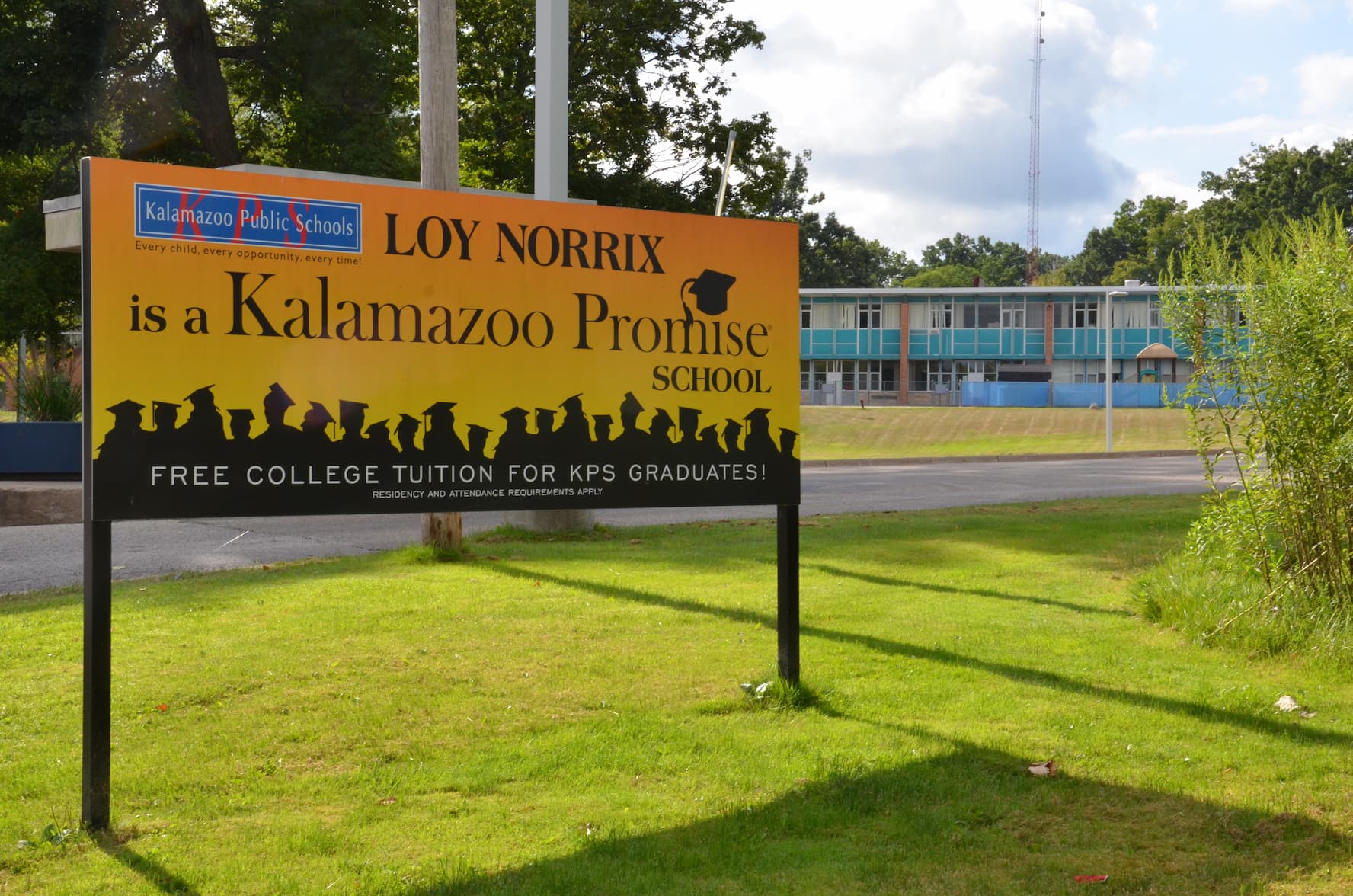
A substantial body of evidence examines the effects of local promise programs, which cover college costs for students graduating from specific cities or metro areas. The Kalamazoo Promise Scholarship, announced in 2005 in Kalamazoo, Michigan, is one of the most extensively studied local promise programs. Studies find that this generous, “first-dollar” scholarship increased immediate college enrollment by 8 percentage points and six-year credential attainment by 10 percentage points.
While Kalamazoo operates as a first-dollar program, many promise programs operate as “last-dollar” programs, meaning promise funds only apply to tuition and fee costs that remain after students apply federal aid. Other programs have implanted additional eligibility requirements, or cover fewer semesters of college than Kalamazoo Promise, often as cost-saving measures.
Looking broadly across the research on promise programs, impacts vary across these program contexts and design features. In many cases, it appears that dollar generosity and lower barriers to program access matter for outcomes, particularly enrollment. The El Dorado Promise, one of the most flexible and generous local programs, has yielded some of the largest effects on both enrollment and completion margins, with a 14-percentage point increase in postsecondary enrollment and over 8-percentage point improvement in bachelor’s degree completion. The Pittsburgh Promise, which includes modest merit requirements, increased college enrollment by about 5 percentage points, and persistence by 4-6 percentage points. Programs with tighter eligibility and award limits show weaker enrollment effects. Evaluations of Atlanta Achieves, which caps annual awards at $5,000 and combines place‑, merit‑, and need‑based criteria, found no enrollment impact but sizable gains in persistence and completion, suggesting initial enrollment is especially sensitive to program complexity.
Still, direct aid and program requirements may not be the only program characteristics that influence the outcomes that local programs can yield. Knox Achieves, a local Tennessee program later scaled to the statewide Tennessee Promise, increased both enrollment and degree completion. This was true even among low-income students who likely received little to no direct dollars from the program, given its last-dollar design. At least for some subgroups, positive messaging and a college-going culture appear to be mechanisms through which programs incentivize more students to college. In one of the only randomized controlled trials of a promise program, researchers working in Milwaukee found no effect on college entry, completion, or early adult outcomes. They highlight that the high merit requirements played a role in this (only 12% of students in treated schools received funds) but because of the program design, spillover effects from broader college-going messaging were limited.
Many studies have also examined whether the introduction of a local promise program changes students’ behavior during high school. One study found students were 8-15 percentage points more likely to aspire to earn at least an associate degree following a program’s announcement, with the largest gains among students of color and those from low‑income backgrounds. Evidence from Kalamazoo shows increases in credit accumulation and GPA, particularly among Black students, as well as reductions in suspensions and detentions. Results in El Dorado showed improvements in elementary and middle school test scores.
Less evidence exists thus far on the impact of local programs on longer-term outcomes, largely because these outcomes take years to develop, and data access can be a challenge. Early evidence suggests employment and earnings may not be significantly affected by promise programs (yet) but that recipients may be more likely to live and work locally. Promise programs also affect the local economy, with some studies finding increases in housing prices and reductions in out-migration from cities after introducing a promise program.
Lastly, evidence shows local programs vary in whether they advance equity, with some significantly increasing enrollment among racially marginalized students while others, particularly less generous programs or those with income requirements, do not increase enrollment of historically marginalized groups.
Promise programs: Evidence from state programs
Since most state programs were established in the past decade, there are fewer analyses of how state promise programs impact students’ college enrollment and completion. The most extensively researched state program is Tennessee Promise, established in 2014. TN Promise increased overall college enrollment by nearly 6 percentage points (driven by enrollment in two-year colleges, with some substitution from four-year to two-year colleges), and improved associate degree completion by nearly 4 points. The Indiana 21st Century Scholars program was established much earlier, in 1990, and research on the programs’ impacts found a comparable 5-percentage point increase in college enrollment and 4-percentage point improvement in BA completion.
Research on Oregon Promise found the introduction of the program in 2015 increased two-year enrollment, partially by shifting students from four-year institutions into the two-year sector, and partially by inducing students to enroll who otherwise would not have. An analysis of the New York Excelsior Program found much more muted results, with little to no effect on enrollment in either the two- or four-year sector. Descriptive analyses indicate that in the City University of New York (CUNY) system, this program primarily benefited middle- and upper-income students since lower-income students have typically been able to cover tuition and fees through the combination of the federal Pell Grant and state Tuition Assistance Program (TAP). See our Appendix for more details on state promise program evaluations.
Promise program design and support matters
Several studies have developed typologies of free college programs, beginning with Miller-Adams’ (2015) distinction between expansive versus restrictive and universal versus limited designs, and extended by Perna and Leigh’s (2018) typology of state and local programs. Rosinger, Meyer, and Wang (2021) used an administrative burden lens to show how promise programs vary in application complexity and compliance requirements, differences that may help explain variation in program impacts. For example, one study of local programs found that those with income eligibility criteria, and the associated documentation requirements, did not increase college enrollment relative to programs without income restrictions.
Even when programs are complex, investments in advising can mitigate administrative barriers. In Oklahoma, students whose counselors viewed their role as supporting college access were more likely to receive promise funding and enroll in college, and students at schools that enrolled more counselors were more likely to navigate new burdensome application requirements and receive promise aid. Advise Tennessee, a program that supports students in navigating applications and financial aid, increased applications to the Tennessee Promise and improved college going by 6%.
Guiding principles for state financial aid design
Much of the research cited above connects program design features to tangible outcomes. In addition, we asked our expert roundtable what makes an exemplary program. Here, we draw on those insights and our review of the literature to offer a non-exhaustive list of important design features and highlight exemplary financial aid programs with those features:
While many programs have some of these features, almost no program has them all. This underscores that differently designed programs can have similar effects while operating through different mechanisms. Programs implementing more of these design features are more expensive, and states facing budget constraints often must make tradeoffs between program affordability and access.
Our work compiling evidence on program design features is ongoing, and future efforts in this area will include how program features like those highlighted above relate to student outcomes in state promise programs to best inform how states can design programs that maximize student outcomes while minimizing programmatic costs.
Updating state promise programs for a changing higher education landscape
As the higher education landscape shifts, state promise programs will require deliberate policy updates to remain effective. The recommendations below outline concrete steps states can take to align promise programs with today’s economic climate and higher education landscape.
States should move beyond last‑dollar aid to improve affordability and persistence
Most state promise programs operate on a last‑dollar basis, requiring Pell Grants to be applied first, with state aid covering any remaining tuition and fees balance. In practice, this often means the lowest-income students receive few or no dollars from the state promise program.
However, at the public two-year institutions that many promise programs target, tuition and fees are only 19% of students’ overall costs, compared with 51% for housing and food. First‑dollar programs, such as the New Mexico Opportunity Scholarship, allow students to use Pell funds for living expenses, while other states supplement tuition aid with targeted support for books, housing, or other costs. For example, Massachusetts’ MassEducate program provides an additional $1,200 allowance for lower‑income recipients. These approaches better reflect the broader affordability constraints that shape students’ ability to enroll and persist. While a full first-dollar approach is significantly more expensive for a state to operate, targeted supplements like MassEducate’s approach are less expensive and may more directly target aid to students most in need.
States should update promise program statutes to reflect changing credential pathways
As the higher education landscape innovates, legislation authorizing state promise programs must be agile to adapt to different models. For example, the increasing prevalence of community college bachelor’s degrees (CCBs) provides a smooth pathway for students to continue their education after completing an associate degree. States might consider adapting existing promise program policies that only cover associate degrees to also cover CCB expenses at two-year institutions. States are also increasingly leveraging direct admissions to public institutions, with a level of clarity that mirrors promise program financial aid guarantees. Additional work is needed to understand how this one-two punch of automatic college acceptance and free tuition operates in states with both direct admissions and a promise program.
States should anticipate federal aid changes when structuring promise programs
As highlighted throughout this report, federal, state, local, and institutional financial aid policies overlap and intersect in a complex web to address college affordability. Notable federal shifts may affect the design of state promise programs in the coming years. For example, President Trump’s fiscal year 2027 budget proposal again proposes holding the maximum Pell Grant for the 2027-28 award year at $7,395, the same it has been since 2023-24. Pell also faces around a $100 billion shortfall in the coming decade, with some calling for tightening eligibility to save costs. The Trump administration also continues to call for eliminating the Federal Supplemental Educational Opportunity Grant (FSEOG), though this program was preserved in the enacted FY 2026 budget. If there are fewer federal resources, that puts states on the hook for larger promise grants.
States should prioritize durable and adequate funding for promise programs
State and local promise programs alike express concerns about funding stability, with state stability often shaped by legislative design. For example, Maine’s free community college pilot in 2022 required annual reauthorization and faced proposed termination in 2025. Governor Janet Mills’ recently signed 2026-27 supplemental budget made the program permanent but less generous with tighter eligibility requirements. Legislation can build on existing programs to make them more financially secure or generous. For example, in 2019, the Washington legislature converted the state financial aid program from a capped appropriation to an entitlement that funds all eligible students.
States need more research to inform policy design
In addition to the policy considerations highlighted above, there remain important research questions that would provide policymakers with actionable data to inform the design of state financial aid policies. These include:
- What aid design features affect program uptake and how can states smooth administrative burdens so that eligible students can receive benefits?
- How do local and state programs differ in (a) their effects on college enrollment and completion, (b) their ease of access and levels of administrative burden, and (c) financial sustainability?
- What does debt accumulation look like for promise students, how does debt vary by program feature like merit requirements, and what impacts might debt accumulation have on students that leave college before finishing their degree?
Charting a path forward for state financial aid
State financial aid, including the rapid expansion of promise and free college programs, has become a central lever for improving college access and affordability. The evidence reviewed in this report shows that program design matters: Aid that is generous, simple to access, clearly communicated, and complemented by advising support is more likely to increase enrollment and completion, particularly for students from low-income and historically marginalized backgrounds. At the same time, “free college” rarely covers all costs, underscoring the importance of addressing non-tuition expenses and coordinating state aid with federal and institutional resources. As states continue to experiment with new models amid fiscal and political uncertainty, policymakers face critical choices about targeting, funding stability, and administrative burden. Applying lessons from existing programs can help ensure future investments not only expand access but also better support students through completion.
The Brookings Institution is committed to quality, independence, and impact.
We are supported by a diverse array of funders. In line with our values and policies, each Brookings publication represents the sole views of its author(s).
