

When former President Richard Nixon vetoed the Comprehensive Child Development Act in 1971, it halted what would have become a large-scale, federally-funded national childcare system. Historians widely view that decision as a major turning point that pushed the country away from building a comprehensive childcare infrastructure.
It would be nearly fifty years later before the country would again seriously consider building such a system, as proposed in the Build Back Better Act in 2021 — though that attempt ultimately stalled when the childcare provisions were excluded from the final package that passed.
In the intervening decades, even as most families came to rely on two incomes and women entered the workforce in large numbers, childcare largely remained something families had to sort out on their own, with limited state and federal assistance.
But polling data shows that bipartisan support for publicly-funded childcare exists, even as federal legislative efforts have waned. In pockets of the country, there has been state-supported investment in childcare, often due to frustration with low wages, high turnover, poor outcomes and unworkable conditions. In the past three years, for example, New Mexico and Vermont have passed groundbreaking childcare policies, strengthened infrastructure and increased access.
Childcare has gained visibility and some political leaders, including Sen. Elizabeth Warren, Vice President Kamala Harris and Mayor Zohran Mamdani, have elevated childcare as a key economic issue for voters. But childcare has more often been a secondary issue in political campaigns, rather than a career-shaping priority for candidates. It’s typically a bullet point for family policy or affordability, rather than the key legislative accomplishment vaulting a candidate to public office.
That may be starting to change.
As more early care and education policies are enacted, the leaders involved in those endeavors have an opportunity to use their experiences to run for higher office.
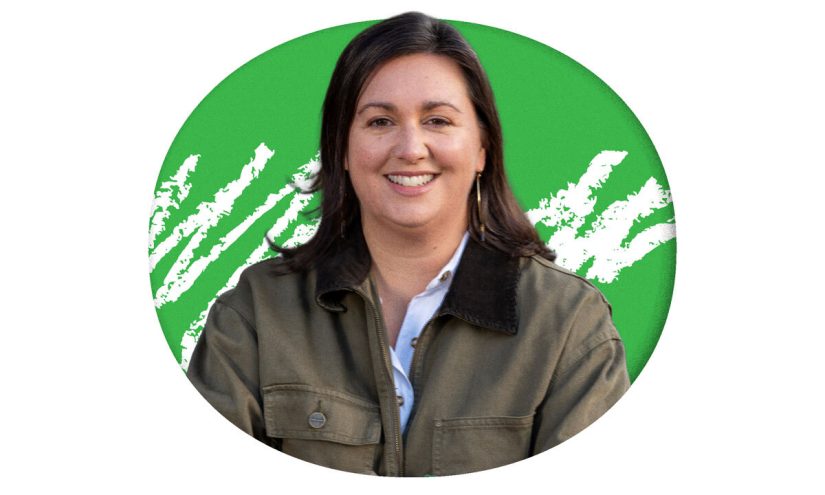
In Vermont, Aly Richards — who led a statewide advocacy organization focused on improving access to high-quality childcare for nearly a decade — announced this month that she is running for governor. She will compete in a Democratic primary in August, and the winner will face Republican Gov. Phil Scott in the general election this fall.
Aly Richards, a longtime childcare advocate, kicked off her campaign for Governor in her hometown of Newbury, Vermont on April 6, 2026. (Josh Wallace)
The organization Richards spearheaded, Let’s Grow Kids, drove efforts to pass Act 76, a landmark legislation that brought significant investment and key policy changes to Vermont’s early care and education system, funded largely by a new payroll tax. The state raised reimbursement rates for early childhood programs, and provided breaks to most families to cover the cost of care.
Could Richards’ success in passing childcare policy translate to support from voters in her run for governor?
In a conversation with Rebecca Gale, Richards explains why childcare is an ideal upstream issue to tackle affordability for families, why other states keep calling her to ask for advice on their own childcare systems, and how the governor’s office might be the best next step for someone who knows just how central quality childcare is for families — and states — to thrive.
This conversation has been edited for length and clarity.
You began with Let’s Grow Kids a decade ago. What was the intended goal at the time, both for the organization and for you personally?
The only focus was the mission. I really had no thought of what I was going to do with myself afterward, because I’m a really mission-oriented person and it was such a gift for me to have a goal and a deadline.
I like to think about what is the one thing a human can do to make the biggest positive impact in the world. And when I realized early childhood education was that lever just sitting there — where our inaction is causing all this detrimental harm to our society and the action [needed] is very clear and concrete — it felt obvious. It’s within our power to [change]. And when you do, it has this immeasurable impact downstream on all these things that we care about.
So the mission was to make that impact through Let’s Grow Kids — like an entrepreneurial-minded enterprise that would do whatever it takes to meet this deadline and this mission of putting in motion a system of high-quality, affordable childcare for the whole state. And we did that.
And while the job is not completely done, we set it in motion in the machinery of the state government. So we really were able to back away having done exactly what we hoped — creating the machinery, the dedicated funding, the ecosystem that will carry it forward and an aspirational model. We showed it’s possible to do this.
Why This Vermont Child Care Organization Was Designed to Sunset After a Decade
What are two or three key changes that you view as central to the state’s early care and infrastructure system?
The No. 1 change is dedicated public investment, because the problem with childcare in this country, since the beginning of time, is that there’s not enough money in the system from parents, who are the only payers.
To fund the system to be functional, to pay early childhood educators a livable wage, to have enough supply to meet the demand — you need a dedicated permanent funding stream. You can have more childcare, it can be higher quality, it can pay wages and it can meet the needs of your community. But that’s the No. 1 thing.
Two and three are the mechanism by which we did it. We basically took a system that already was in place and pushed the public investment into the hands of Vermonters through reduced childcare costs. By going up to that 575% of the poverty level [the threshold in which a Vermont family can now qualify for childcare subsidies], you’re making almost $200,000 as a family of four and you’re seeing reduced childcare costs, which is making life more affordable. We also increased the reimbursement rate to programs.
It put money in the hands of Vermonters to make it more affordable. It put money in the hands of early childhood education programs so they could actually run their programs, pay higher wages and meet the needs of their families. And that’s why I think we’re seeing the implementation work so well. It’s adding more spaces, adding more businesses and reducing costs for families at the same time, which is what’s spurring our economy. It’s the one area of growth we’re sort of seeing in Vermont right now.
Amid Budget Cuts to Child Care, Dedicated Funds Hold Promise
There are still very few leaders who’ve built their careers around childcare policy. Do you see this as a structural roadblock to progress? I envision it as sort of a “Lego ceiling” — a barrier built piece by piece through fragmented policy and underinvestment, that could be taken apart if priorities shift. What would change if more leaders made childcare a signature issue?
Yes, yes and yes. Let’s bust that Lego ceiling into a million pieces so they’re on the floor when you step on them accidentally, like in my family all the time.
Look, it is exhilarating for me to be moving into this new world of politics from that background in early childhood education and policy, because it’s not just early childhood education. It’s problem-solving in a dynamic way for the issues we face in the 21st century.
I spent my last decade working to solve this deep crisis that dogged Vermont and has dogged the rest of the country. I grew up in Vermont. I went out of state to change the world, working on Obama’s first campaign. I was so excited by his leadership potential, and yet I was so dismayed by the lack of action in D.C. because people who didn’t agree with each other didn’t speak to each other anymore.
Children turned out to support Aly Richards for Governor at her campaign kickoff, including her twin sons, Beau and Wesley. (Josh Wallace)
I know enough to know that’s not how real change happens. You have to be in the room together. You have to be able to have reasonable agreement and disagreement.
So I raced home to Vermont and started working for the governor, and started realizing — talking to Vermonters from all walks of life — that what was broken in D.C. was not broken here in Vermont. We still talk to each other, and at the end of the day we can get pizza together and a beer even if we disagree. I quickly realized that early childhood education was one of these rare things where if you go upstream, it will solve all these other problems. It’s a way of viewing the world that I think we must focus on in the 21st century. We have real structural issues in Vermont and in this country. We have to go upstream, understand what those structural issues are and change them.
Childcare is a perfect example. Take Vermont. We have jobs. It’s a misconception that we don’t. We just don’t have anyone to fill them. A large reason is because we can’t find or afford childcare.
I paint this picture for you because to me that is the whole basis of the answer to your question. [Childcare] needs to take the country by storm, and it’s starting to in places like Vermont.
You’ve mentioned that other states have reached out to you about making childcare more affordable. How do you see this conversation changing if you become governor?
Well, it puts it out in the universe in a very different, meaningful way. Affordability will make or break this country right now. And here’s a concrete example of making life more affordable tangibly for your citizens.
So I’ve been all over the country, honestly — in person and on webinars in the past couple of months — spreading the model of what we did in Vermont through Let’s Grow Kids.
Can you imagine the National Governors Association having a childcare meeting where we all say: What’s worked in your state? What hasn’t worked in your state?
Aly Richards and her husband James Pepper at home in Montpelier, Vermont, with their 7-year-old twin boys, Beau (blue socks) and Wesley (red socks), and their dog Ellie. (BattleAxe Digital)
Who are the leaders? Get them together, accelerate this — because it’s great for your citizens and great for your economy. And it’s now a low-risk proposition because states have already done it and showed it’s possible.
I think there’s an amazing opportunity there.
Did you use this article in your work?
We’d love to hear how The 74’s reporting is helping educators, researchers, and policymakers. Tell us how
