

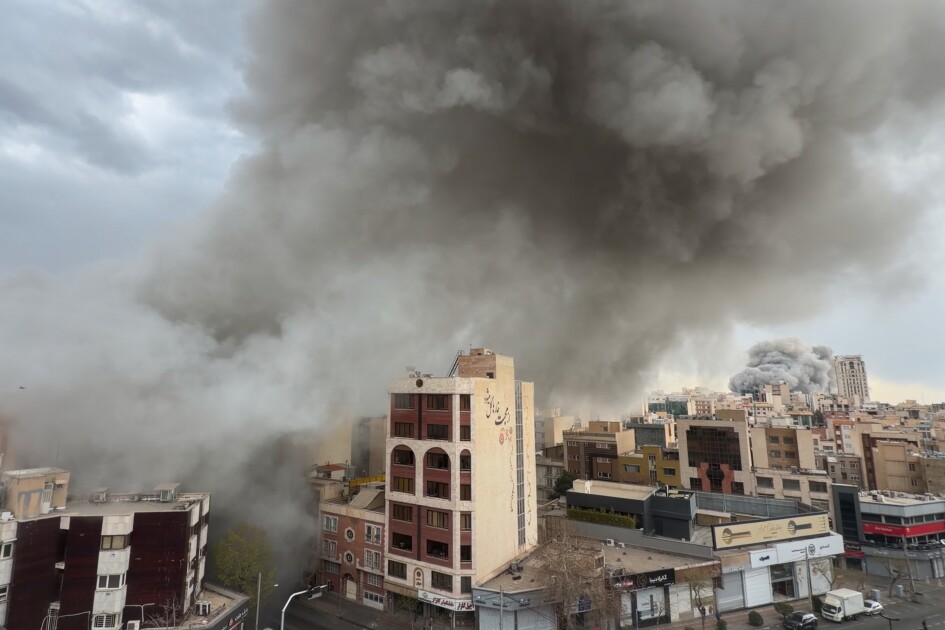
As the war in Iran continues to dominate the headlines, educators have been navigating how to best address the controversial subject in the classroom.
EdWeek recently asked three school leaders how teachers in their schools are approaching the topic in class. They said, despite the volatility of the topic, classroom discussions of the conflict in Iran have been relatively muted.
“We haven’t had many kids asking questions,” said Jason Johnson, a principal at Orange High School in North Carolina and one of the leaders who spoke to Education Week. “But our strategy with anything that’s controversial, such as the Iran war, we always focus on the standard within the social studies curriculum.”
Educators being uncertain about how to best navigate controversial topics comes during a time when addressing them in the classroom can have damaging consequences.
Last month, education nonprofit and advocacy group iCivics released a survey of nearly 2,200 K-12 educators about their classroom instruction and the climate of teaching civics. Nearly 53% said teaching basic civics concepts now feels difficult, and about 59% are concerned about a backlash for teaching something the “wrong way.”
“There is a concern of teachers being interpreted as partisan or pushing agendas,” said Andrea Garza, the dean of the early college academy at United High School in Texas and one of the leaders who spoke to Education Week. “[But] teachers naturally are in this profession because of an altruistic ideal on building the thought process and building students to be great thinkers. And that includes talking about things that are difficult.”
Over the past decade, educators have grappled with how to address divisive, large-scale events during classroom discussions, including the Covid-19 pandemic, a contentious presidential election, impeachments, protests, and US involvement in international conflicts.
In addition, the federal government has taken unusual steps recently to try to influence the tenor of school lessons. The Trump administration has sought to discourage lessons on race and gender topics, and instead pushed schools toward a “patriotic education” and lessons on the United States’ origins as a nation.
Some educators have changed their approach to covering certain topics because they feel under scrutiny. Thirty-five percent said they are changing or removing lessons, according to the iCivics poll.
“We are navigating in a society where teachers fear being misinterpreted, misconstrued, [being accused of] pushing one side or the other, corrupting or having an agenda,” Garza said, “and so teachers are having a hard time trying to find a fairly safe, nonpartisan way to present information.”
“Sadly, I feel teachers may pull back more now than they ever have before.”
Why schools might not be talking about Iran
Earlier this year, the United States and Israel launched attacks against Iran’s military and infrastructure and eventually killed the country’s supreme leader, Ayatollah Ali Khamenei.
Most recently, the two countries have agreed to a temporary ceasefire and they are in discussions about finding a way to end the war.
Education Week spoke with three educators across the country about how the war in Iran hasn’t been a topic of discussion in the classroom, but how they are preparing for those conversations when or if they come up.
At Woodland Middle School in Brentwood, Tenn., Assistant Principal William “Bill” Toungette said students aren’t asking about the war, nor are they searching it online.
“We have an online filtering system that we use, and it catches any kind of concerning topics,” he told Education Week. “I monitor that pretty closely each day [and] I haven’t seen anything that would have gotten hung in regards to the war.”
When more politically charged topics reach the classroom, he advises his teachers to stick to the curriculum. “We can’t always put our opinion out there, said Toungette, who was a finalist for the 2026 National Middle Level Assistant Principal of the Year award. “We have to be responsible [because] we have impressionable kids, and we should be as neutral as we can.”
Johnson said he hasn’t heard any students asking about the war in Iran either. But his teachers do get training on how to handle politicized topics—sometimes by avoiding them. “We work with attorneys who have coached us in terms of topics to stay away from,” Johnson said. For example, “you definitely don’t get into deep political conversations with your students, especially given the climate today.”
If the topic needs to be addressed, he advises teachers to follow the curriculum and stick to academic standards.
“As a classroom teacher, you bring yourself into that classroom, meaning you bring your own lived experiences into that classroom, but at no point should you be bringing your personal feelings about it,” he told Education Week. “That’s why it’s so important for teachers to teach towards the standards.”
Garza doesn’t believe the war in Iran has emerged as a central topic in classrooms in her school. But from her observations, teachers are holding back.
“Public school teachers feel [the need] to be more censored, tiptoe and be delicate because society is picking apart public education,” she said.
Garza has seen teachers talk about controversial topics in class in the past, and later on, parents have objected, at times resulting in an investigation by the administration.
“This is what silences or ends up inhibiting our teachers from their craft,” said Garza. Topics like the conflict in Iran are difficult to navigate because “nobody wants to be interpreted as having one opinion or another.”
Educators are prepared to address difficult topics in class
When teachers need to take on controversial topics in class, Toungette urges them to create and maintain a respectful environment. This starts with how teachers bring up a topic, to then ensuring students keep a respectful tone, Toungette said.
“We’re very careful about what we say, about the sources that we use in our presentations,” he said.
Johnson said one way his school has navigated controversial topics in the past is through a student group called Students to Students. The organization has discussed a number of potentially divisive topics, such as the value of public education and the LGBTQ community, he said.
“Students today are very open to all types of conversations, and they typically don’t take one side or another,” said Johnson. “They do a much better job of listening than the adults do.”
For Garza, the most important part of addressing controversial topics, whether it’s the conflict in Iran or another issue, is grounding them in the facts. That means understanding the motivations of the parties involved and the historical timeline of events, she told Education Week.
She suggested teachers use maps and primary source documents to anchor any kind of discussion. Teachers should also play devil’s advocate to make sure students are looking at various perspectives of military conflicts like the one in Iran, Garza said.
“Let’s present both arguments so that students aren’t being told what to think,” she said. “But are practicing how to think or how to analyze information.”
