

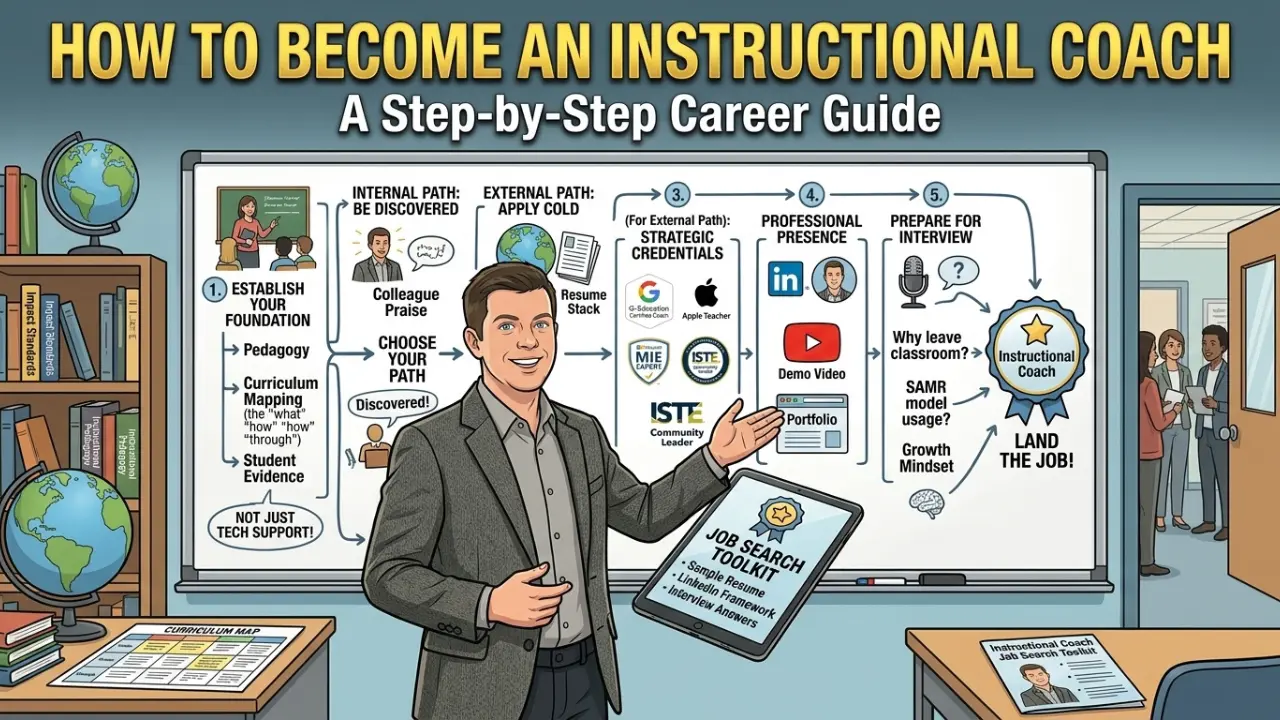
Every Instructional Coach has a different origin story. Some were “discovered” in their own buildings — the teacher everyone already turned to for help. Others made a deliberate career pivot, armed with certifications and a portfolio of work that spoke louder than any resume.
Neither path is wrong. But both require intentional steps.
When I made the jump from being an orchestra teacher into my first coaching role in a five-building K–12 district, I’ll be honest: I didn’t fully know what I was doing… at first. My title was “Tech Coach” (and sometimes “Coordinator of Instructional Technology”), and I quickly learned that titles shape expectations. Too often, teachers assumed I was there to fix devices—not support instruction. It took a lot of listening, relationship-building, and eventually a simple but powerful rebrand to “Instructional Coach” before the work started to click.
So what does that transition actually look like in the real world? Here’s a clear path you can follow — whether you’re being tapped on the shoulder or applying cold to districts that don’t know your name yet.
Step 1: Understand the Role Before You Chase It
Before you update your resume, make sure you actually want this job. Instructional Coaching is fundamentally different from classroom teaching:
- You won”t have your own students anymore.
- Your success is measured by other people’s growth.
- You’ll navigate complex relationships with teachers, administrators, IT, and central office — all in the same day.
- Some days your calendar is completely empty. Other days it’s wall-to-wall.
As I write in Impact Standards, “Instructional Coaching is a seesaw. What works between you and one staff member might not work between you and another.”
If that excites you more than it scares you, keep reading.
Step 2: Build Your Teaching Foundation
If you want to be taken seriously as a coach, you have to lead with something bigger than “I’m good at tech.” You have to lead with what you already are right now: a teacher who understands instruction.
In Impact Standards, I describe curriculum work like this: districts are great at outlining the “what” (standards, units, pacing), but too often we fail to define the “how” (instruction) and the “through” (the tools and learning experiences students use to show mastery). When a coach can help teachers strengthen the how and the through—without adding more stress—that’s when coaching becomes transformational.
So before you chase a coaching title, build a career story that clearly shows you are a master of:
- Pedagogy — you can plan instruction, anticipate misconceptions, and adjust in the moment.
- Curriculum & unit design — you can break standards into teachable chunks, build assessments, and map skills across a grading period.
- Student evidence — you can point to student work, growth, and outcomes (not just projects).
One of the fastest ways to prove this is to think like a curriculum mapper. A good curriculum map doesn’t just list chapters—it shows when skills and standards are taught, assessed, and reinforced, and how your course fits into the bigger K–12 puzzle.
Bottom line: the strongest coaching candidates don’t sound like “tech support.” They sound like instructional leaders who can design learning that actually moves the needle.
Step 3: Two Pathways — Internal Discovery vs. External Application
The Internal Path: “Discovered” in Your Building
For many coaches, the transition happened organically. They were the teacher who ran PD sessions after school. The one colleagues came to with tech questions. The one the principal noticed leading from the middle.
If this sounds like you, the coaching position may have been created for you. In these cases, professional certifications aren’t always required because district leadership already knows your skills and your character.
The External Path: Applying to Districts That Don’t Know You
If you’re applying to a district where nobody knows your work, you need proof. This is where certifications, a professional portfolio, and a visible online presence become essential.
You need to answer one question before they meet you: “Why should we trust this person to coach our teachers?”
Your credentials, your content, and your reputation answer that question before you walk in the door.
This is exactly why I talk in Impact Standards about credentials and professional associations. If you’re being “discovered” inside your current building, you might not need badges at all—your leaders already know your work. But if you’re applying to a district where nobody knows you, micro-credentials and PLCs become shorthand for three things: competence, credibility, and self-driven growth.
Interested in a Career as an Instructional Coach?
Want a clear next step (and more resources like this)? Start here: my Instructional Coach Career Growth Hub — a free collection of guides to help you move from classroom teacher to coach with confidence.
Step 4: Get Credentialed (Strategically)
Not all certifications are created equal. Focus on what matches the districts you’re targeting:
Tier 1 — Major Programs:
- Google Education: Level 1 → Level 2 → Certified Coach → Certified Trainer
- Apple Education: Apple Teacher → Apple Distinguished Educator
- Microsoft Education: MIE → MIE Expert → Microsoft Trainer
- ISTE+ASCD: Community Leader program (year-round professional network)
Tier 2 — Ambassador Programs:
- LEGO Education, Canva, PowerSchool
- These are more grassroots, tighter communities, and great for building your network
Pro tip: If a district runs Google Workspace, show up with Google certifications. If they’re a Microsoft shop, lead with MIE credentials. Match your badges to their ecosystem.
Step 5: Build Your Professional Presence
Here’s what I learned the hard way: “It is not the format of the resume that gets you in the door for an interview — it is the content that is on it.”
Beyond the resume, you need:
- LinkedIn — Upload a professional photo, list your experience, and post about your work. This is where districts look first.
- YouTube — If you’re applying for a coaching position, you MUST have a YouTube channel. Districts want to see that you can present, tell a story, and hold attention.
- Portfolio — A Google Site, WordPress page, or Wakelet collection showing your best work. Build it piece by piece throughout the year, not the night before an interview.
- Social Media — Use Twitter/X, Bluesky, and Facebook groups to connect with other coaches and make your name known in edtech circles.
Step 6: Prepare for the Interview
Coaching interviews are different from teaching interviews. Expect:
Common Interview Questions:
- Why do you want to leave the classroom to become a coach?
- Tell me about a situation where you were in a mentorship role with another teacher.
- How have you used the SAMR model or 4C’s to create a lesson?
- Teacher X is working on Y project — how would you approach them?
- Describe your most memorable professional development experience.
Performance Tasks You Might Be Asked to Complete:
- Create and deliver a demo lesson using an application popular in the district
- Design two PD sessions on a single topic — one for large group, one for small group
- Create a short video tutorial
- Bring a portfolio displaying previous work
The most important quality? Growth mindset. No candidate knows everything. There’s a significant difference between hearing “no” and “not yet.”
You can do this (and you don’t have to do it alone)
If you’re reading this and thinking, “I’m not ready yet,” here’s the truth: you don’t become “ready” and then start building your coaching story—you build it one rep at a time.
Start with what you already do well:
- Teach a strong lesson.
- Design a clear unit.
- Collect student evidence.
- Help one colleague.
- Repeat.
That’s coaching. And if you keep stacking those reps, the job title eventually catches up.
Free resource: Instructional Coach Job Search Toolkit
If you’re serious about making the move, don’t try to “wing” your job search.
Hiring committees don’t just want a great teacher—they want proof that you can support adult learners, build trust, align coaching to district priorities, and communicate measurable impact.
That’s why I put together the free Instructional Coach Job Search Toolkit—a step-by-step career hub built specifically for educators who are ready to move into coaching.
Inside the toolkit, you’ll find:
- Sample instructional coaching resume (with coaching-specific language + measurable impact bullets)
- Sample LinkedIn profile framework (so your profile reads like a coaching portfolio)
- Interview questions + answer examples (so you walk in prepared)
- A 7-day job search action plan (so you know exactly what to do next)
Best next step: start with the resume resource, then update LinkedIn so your online presence matches the story your resume tells.
Like this:
Loading…
