

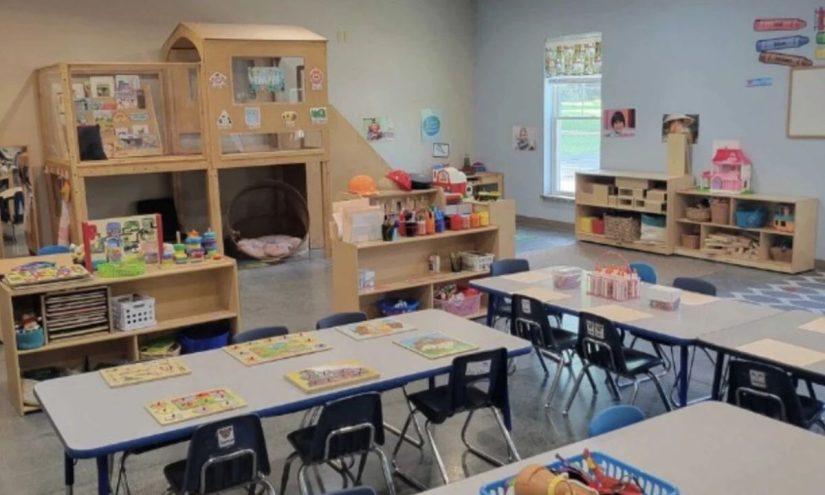
Nicci Rexroat, owner of A Place To Grow pre-kindergarten center, has worked in child care for 19 years, and she’s beginning to believe most of Missouri has become a child care desert.
“You know, I have families calling me every day looking for spots, and we’re full in Jefferson City until August of 2027,” Rexroat said.
Rexroat opened A Place To Grow in Holts Summit in 2015 before adding two locations in New Bloomfield and Jefferson City in 2023. Since her initial opening she’s received subsidies from the state that help families pay their tuition expenses.
Over time, she said she has seen the number of families in need of extra help increase exponentially.
“I think one of the big problems is that the economy is a little tighter,” Rexroat said. “Everything is more expensive.”
Last month, the Missouri House proposed a $51.5 million cut to the child care subsidy program that would have specifically targeted enhancement services that help low-income children, including those in foster care, receive quality care. The cut also would have made it harder for accredited day cares to pay staff who meet higher education requirements.
But the Missouri Senate restored that funding in its version of the budget bills passed on Wednesday. That could still be changed by the House or vetoed by Gov. Mike Kehoe before the budget is signed into law.
The child care subsidy program provides assistance to more than 27,000 families, according to the Missouri Department of Elementary and Secondary Education. In order to receive support, families must have children under the age of 13, be below 150% of the federal poverty line and need child care to work. Once a family is deemed eligible by the Office of Childhood, they are connected with an approved subsidy provider. Subsidy funds are later distributed to that provider by the state based on a set rate.
“It is kind of like a voucher for families to have child care,” said Casey Hanson, deputy director of Kids Win Missouri.
The number of families that qualify for the program has increased by 19% since January of 2025, according to DESE, which led the Office of Childhood to begin implementing a program waitlist in March.
Hanson said the increase is most likely due to current economic conditions and possibly a surge in the number of children enrolled in child care since the Covid-19 pandemic.
She said she hopes when people look at the number of families on the waitlist they remember why the program exists.
“Subsidy is a program for working families, for families that are in school, for families that are in job training, and for our foster and adoptive families,” Hanson said. “These are families that need childcare to be able to care for their children, to be able to thrive on their own as a family.”
If the cut would have gone into effect, Rexroat feared she would have had to limit the number of services she provides.
“We will have to lower the amount of foster care children that we can provide services to, which is not great for anyone and is not why we’re in the business of early childhood,” Rexroat said.
Rexroat has been in the process of gaining accreditation at all three of her centers over the past couple years. She promised her staff a bump in pay if they were to meet accreditation requirements.
The uncertainty surrounding the potential budget cuts have made her doubt her ability to follow through.
“I am worried about staff retention if I can’t deliver on that promise,” Rexroat said.
Seeds of Faith Preschool in Clinton has been accredited for three years. Owner Amber Hansen did not expect her center to not be as heavily impacted by the cuts, but was concerned about how other providers would be impacted further down the line.
“We may not see it in the next three months, but I mean, a lot of child care centers are hurting across the state right now,” Hansen said. “You got to think about food cost, you got to think about keeping the lights on. We have bills too.”
Hanson of Kids Win Missouri said even with funding being restored by the state Senate, there is still a long road ahead. However, she feels there’s more understanding of the issue at hand.
“We still have a child care crisis happening, we still have a waitlist, I think everyone understands there’s got to be further discussions around how we can try to balance maximizing access for families, getting that wait list reduced but also ensuring that we’re sustaining our providers,” Hanson said.
This story originally appeared in Missouri Business Alert, a digital newsroom covering businessand the economy in Missouri.
