

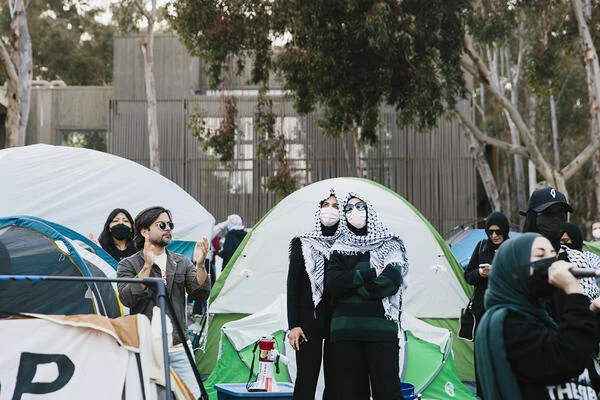
Faculty supported students at the University of California, San Diego, during their six-day encampment in 2024 to protest Israel’s war in Gaza.
Katie McTiernan/Anadolu/Getty Images
Two years have passed since the height of student and faculty protests against Israel’s war in Gaza. Encampments are gone and most student activist leaders have graduated. But some professors who took part in the demonstrations are just now beginning to face disciplinary action or retaliation for their speech during that time.
BT Werner, an environmental physics and complex systems professor at the University of California, San Diego, is among them. Werner was notified two months ago that they had been charged with violating the faculty handbook. The alleged infraction occurred nearly two years ago during a six-day student encampment, where Werner and other faculty spent “the night shift” protecting students from potential violence, they said.
UCSD began investigating Werner in June 2024. After they exchanged some emails that month with university officials and an outside law firm working with the university, Werner heard nothing more about the investigation. It wasn’t until February that they received notice of the charge.
“This isn’t the university trying to fairly administer discipline,” Werner said. “It’s 100 percent political prosecution.”
Werner declined to discuss the details of the incident that landed them under investigation, citing legal advice. UCSD spokespeople did not respond to a request for comment on Werner’s case. A disciplinary hearing before a faculty panel is scheduled for May.
Werner called their case an example of the “Palestine exception,” a term coined to describe patterns of institutional discrimination and enforcement that apply only to speech related to Palestine.
“No one who is trying to restrict speech about Palestine—which, of course, is illegal—is going to talk about it openly,” Werner said. “[But] what’s happening on the UCSD campuses, on other UC campuses, on university campuses in the U.S. in general—is that the Palestine exception to free speech? … The answer is yes.”
In 2025, Palestine Legal, a nonprofit focused on providing legal aid to those who advocate for the Palestinian people, received 1,131 requests for legal support, and 663 of those requests came from university students, faculty or staff facing backlash for their campus activism. The lawsuits have continued into 2026: In Texas, Sajida Jalazai said she plans to sue Trinity University after top administrators denied her tenure despite recommendations from the religion department, dean of the college and a universitywide commission on tenure and promotion. Leaders told her she failed to meet the publication standards required for tenure at Trinity, she said, in part because two of the publications she used in her tenure case were chapters in edited volumes.
“Administration is saying that these chapters don’t count towards tenure because they are not double-blind peer reviewed,” Jalazai said. “However, the religion department does not require double-blind peer review. It’s been an established precedent in my department that these types of publications—chapters in edited volumes—definitely count towards tenure.”
Jalazai suspects her tenure was denied for another reason: her involvement in a November 2023 teach-in about the Israeli-Palestinian conflict, during which she discussed the history of Zionism.
“The only conclusion that I can come to is that this work that I’ve done on Palestine education and advocacy has somehow become a factor in their assessment,” Jalazai said. “I think this is because of the general climate—the suppression and general crackdown on student groups and faculty groups about Palestine, donor complaints, alumni complaints, things like that.”
A spokesperson for Trinity University said the university does not comment on specific personnel cases, but noted that in every tenure case, “the university takes very seriously its responsibility to apply standards consistently, fairly and in alignment with the expectations Trinity sets for all tenure-track and tenured faculty members. To do otherwise would be unfair to colleagues who have achieved these expectations and would compromise the credibility of Trinity’s process and standards.”
Courts Will Have the Final Say
Jalazai and her lawyer, Lonny Hoffman, a law professor at the University of Houston, are waiting for the go-ahead from the Equal Employment Opportunity Commission to file their claim. In the forthcoming suit, Jalazai will seek a “declaration that she was improperly denied tenure,” as well as reinstatement, back pay and damages, Hoffman said. The Trump administration has sued and withheld funding from universities for their failure to address antisemitism, and this has made officials even more reluctant to protect any faculty members who advocate for Palestinians or criticize Israel, Hoffman explained.
“This is part of the trend that we’re unfortunately seeing ever since the [Trump] administration took office, which is that everyone seems to believe that the best thing to do is duck and hope it will all work out in the end,” he said.
Ramsi Woodcock, a law professor at the University of Kentucky who describes himself on his personal website as an “Antizionist scholar,” has been on leave since July 2025. He was suspended for posting an online petition calling for military action against Israel, and the university’s investigation into his extramural speech is ongoing. In January, a federal judge ruled that Woodcock may not return to the classroom while the investigation continues.
Idris Robinson, a tenure-track philosophy professor at Texas State University, is also taking legal action after his contract was terminated this spring. University leaders decided to end his employment after they learned he gave an off-campus, unaffiliated talk about Israeli-Palestinian relations. He’s the second Texas State professor to be fired for off-campus speech; in September, history professor Tom Alter was fired for giving an extramural talk that month that referenced a hypothetical overthrow of the U.S. government.
Robinson’s talk, titled Strategic Lessons From the Palestinian Resistance, took place in 2024 at a North Carolina anarchist book fair, The Guardian reported. He never finished the talk; a fight broke out after several minutes when an audience member announced that some pro-Israel attendees were live-streaming the event, and Robinson was led out of the room. A year later, pro-Israel social media accounts began calling for Robinson to be fired, and he was placed on administrative leave in June 2025. In July, Texas State notified him that his contract would end in May.
