

Last summer, the American Federation of Teachers wanted a “seat at the table” with the technology giants developing K-12 artificial intelligence tools. Less than a year later, AFT is pushing to close classroom doors to much student AI use.
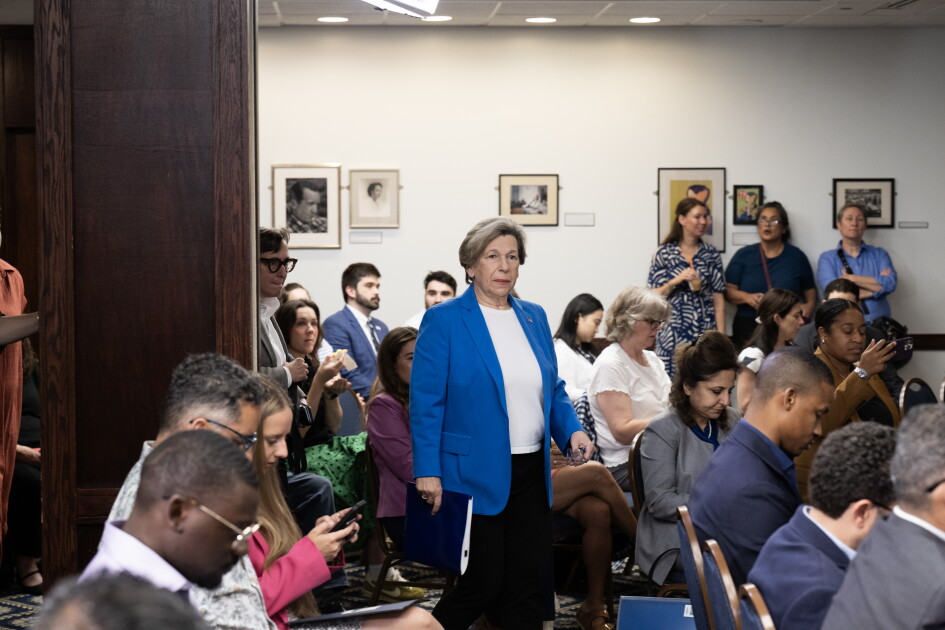
On Wednesday, the president of the 1.8 million-member union, Randi Weingarten, called for wide-scale rollbacks of student use of digital technology in the classroom, restrictions on student-focused AI tools, and greater research and teacher training on safety and privacy issues related to AI use.
“Intentional or not, all this tech has been a huge experiment on kids, and experiments can go wrong,” Weingarten said at a briefing at the National Press Club. “We need to take stock so we can do what we know is right. But teachers, parents, and school districts cannot manage the tech juggernaut on our own.”
AI has the potential to change work and workplace conditions across many industries, including education. Public school teaching is among the most heavily unionized professions in the United States, and AI will be an issue in “virtually every contract negotiation” this year, Weingarten said.
“There’s more to [AI] than just what the tools are. It’s more about, what are the safeguards and where is this leading?” said Leah Van Dassor, the president of the St. Paul, Minn., teachers’ union, an AFT affiliate, which recently included language on AI in its new labor contract. “Sure, if [AI] is going to make my job faster and easier, awesome—but only as long as people are still making the deep decisions that need to be made through their critical thinking.
“When that starts to get eroded, that is a concern.”
Limiting classroom screen time
At least 38 states have so far restricted or banned mobile phones in school, according to an Education Week tracker. Teachers in those states, Weingarten said, report that kids are noticeably more engaged.
“Hallways and lunchrooms bustle with chatter and laughter again now that students aren’t heads down, eyes on their phones,” she said.
The union wants to extend digital restrictions in schools to ban:
- All screen use under grade 3, including online tests, without a “compelling reason,” such as supports needed for students with disabilities;
- All “student-facing” artificial intelligence, such as digital tutors, in elementary school; and
- “Companion chatbots,” including any AI-based program that simulates human relationships, for students under age 16.
AFT has pushed states and districts for wide-scale teacher training on AI issues and effective use, and said secondary students should use AI-based tools only under teacher supervision.
“I try to tell my students, you’re very smart, but you don’t have strong critical-thinking skills yet, and if you’re relying on AI to do that, you’re never going to have it,” said Sari Beth Rosenberg, a U.S. History and Advanced Placement U.S. History teacher at the High School for Environmental Studies in New York City. “And then you’re not going to be prepared for a world where AI is replacing any job that’s a template.”
Last summer, AI firms including Anthropic, Microsoft, and OpenAI partnered with AFT to create a five-year, $23 million National Academy for AI Instruction to train teachers.
So far, Weingarten said the AI firms have “kept their promises” to refrain frominfluencing the teachers’ training curriculum—but they have been slower to fully sign on to the Academy’s “gold standards” in safety, privacy, and data security for companies that want to work in K-12 schools, because they’d have to change their products.
But the new plan explicitly calls for the federal government to develop AI safety research and teacher training independent from AI developers.
“There’s a lot of children-facing AI that has been sold to school districts for the last several years,” Weingarten said. “I am not calling for a ban on AI or a bonfire of Chromebooks. I am calling for the tech industry to not have this overwhelming influence that basically stops legislatures from doing what they need to do, to protect society and to protect our children.”
AFT also called on the federal government to strengthen intellectual property rights in AI contexts and to impose a tax on the major technology companies, to be put toward mitigating AI-related job disruption; it was not immediately clear if such a tax would be limited to those developing AI tools.
I am not calling for a ban on AI or a bonfire of Chromebooks. I am calling for the tech industry to not have this overwhelming influence that basically stops legislatures from doing what they need to do.
Weingarten also linked the tech companies’ dominance to what the union sees as other social ills.
“Artificial intelligence is accelerating the steepest upward transfer of wealth in modern history,” she said. “Tech kingpins and corporations can afford to pay a fair tech tax; workers, communities and the Earth can’t afford for them not to.”
AFT’s prescription for AI use was situated in a larger plan that hews to traditional progressive education proposals: increasing public education funding, and redesigning curriculum and accountability to focus on foundational literacy, numeracy, civic engagement and student well-being.
Rosenberg, the New York teacher, noted that many of her students voice concern about AI’s potential effects on themselves and the environment.
“But they still use it,” she said, “so I agree with [Weingarten]: We need to work with these companies. We need to teach kids how to use it.”
