

Join our zero2eight Substack community for more discussion about the latest news in early care and education. Sign up today.
This April, the parent of a Head Start student in Washington state went to an immigration office to turn in his paperwork. While there, he was detained. As of last week, the father still hadn’t been released and his child stopped attending school.
The preschooler’s prolonged absence was related by Decca Calloway, the executive director of early learning at Puget Sound Educational Service District in Renton, Washington. And this young learner was not the only one to feel the effects of the Trump administration’s immigration crackdown, said Calloway, whose district serves nearly 1,000 Head Start and roughly 360 Early Head Start children across two large counties.
“Many children stop coming to school,” she told The 74. “It happens to one family, but most of our families — especially our immigrant community families — are really tight knit (and) they take each other’s children to school. So when you have one child or one family afraid, you essentially have many families and many children afraid.”
Calloway is one of nearly 300 Head Start directors, parents and teachers across seven states who participated in an April survey, which found that Immigration and Customs Enforcement actions are causing significant fear, stress and disruption for preschool-aged children and their families.
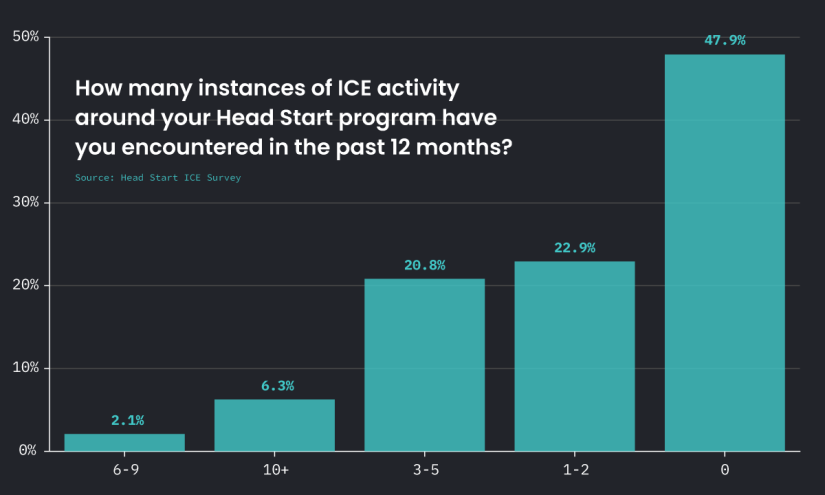
In total, just over half of surveyed Head Start leaders reported at least one instance of ICE activity near their facility within the past 12 months, and 6% noted that activity was during particularly vulnerable school pickup and drop-off times.
Nearly 80% of surveyed staff reported that ICE enforcement has had a noticeable impact on student attendance: On average, surveyed programs have experienced 7% of their students disenrolling altogether, and 14% of directors said they faced delays in new student registrations, attributing both to immigration fears. Center leaders estimate an average 7% chronic absenteeism rate explicitly tied to ICE, though that number varies drastically among the surveyed districts and states, ranging from 0% at some centers up to a reported 62% in others.
When Calloway analyzed her district’s attendance data, she found that up to 20% more young children were chronically absent this February as compared to 2023, much of which she attributes to increased panic around immigration enforcement. Even before ICE and border patrol officers made their presence known in the state, concerns around impending action had a chilling effect, she said, leading to significant dips in enrollment.
Shifting Immigration Policies Are Changing Daily Life for Child Care Providers
Just under half of all survey respondents said they had observed negative behavior changes in children in response to the crackdown, consistent with clinical symptoms of anxiety, stress and trauma. This has appeared in a variety of ways, including kids having more frequent tantrums and expressing concern around going outside to play. Others have told teachers they’re afraid to leave their homes, “thinking that they won’t see their parents again.”
Children at some centers also appear to be mirroring language they hear on the news or from adults around them. For example, one staff member wrote, “I have had 4 instances (between HS children) where 4 individual, separate white children have told Latino children in their classroom that either the police were coming to shoot them or telling them that they were going to report them and have them sent away.”
The survey was conducted by the Washington, Pennsylvania and Wisconsin Head Start associations throughout April. The groups surveyed 277 respondents in their own three states and across four others: California, Florida, Virginia and West Virginia. Those queried encompassed 90 program leaders, 165 staff members and 22 parents or caregivers.
Sandy Diaz, advocacy and family engagement specialist. (Washington State Association of Head Start)
Sandy Diaz, an advocacy and family engagement specialist at the Washington State Association of Head Start who led the survey, noted that even children who are not from immigrant families are being impacted by ICE enforcement actions.
“It’s everybody in these Head Start communities who is witnessing and hearing about ICE activity (that) is being affected,” she said. “And that ultimately affects the quality of learning that children are receiving.”
‘It wiped out our parent programs’
For nearly three decades, immigration enforcement was largely prohibited in and around schools, hospitals, places of worship and other so-called sensitive locations. But President Donald Trump rescinded those protections as one of his first acts in office in January 2025.
Earlier this year, the Department of Homeland Security faced a 76-day partial shutdown, the longest in history, amid heated debates around immigration. A bill to fund ICE and border patrol stalled in the Senate ahead of the Memorial Day recess, meaning it won’t pass before the June 1 deadline set by Trump.
Head Start Providers Fight to Claw Back Protections from ICE Enforcement
Democrats have demanded that protections for sensitive locations be reinstated as part of any funding bill, yet as it stands, the stalled legislation does not appear to include this provision.
A separate bill, The Protecting Sensitive Locations Act, was introduced in the House in February 2025 and would prohibit immigration enforcement actions within 1,000 feet of places such as Head Start centers and hospitals, except in certain extreme circumstances. Since early January of this year, the bill has gained 33 co-sponsors in the House and four in the Senate, meaning over two-thirds of the Democratic caucus is officially in support. No Republicans have signed on, leaving it in limbo.
Without such protections, providers fear continued harmful effects for their staff and families. Of the nearly 50% of Head Start leaders who reported ICE activity around their program, 3% said it had occurred directly at their site and nearly 10% said it had occurred at a family’s house.
One-third of parents said they were more anxious or cautious about being involved in program activities and felt worried about traveling to their Head Start centers or being in public spaces. Over a quarter said they have changed the way they routinely do pickup or drop-off at their programs.
“Staff have been heartbroken that families ask them if they will be the emergency contact for the child if the parent is picked up,” wrote one provider.
“We have seen a decrease in playgroups/socialization,” wrote another. “Families are not as willing to hang out during drop-off/pickup to speak with teaching teams. More families are requesting transportation for their child, limiting their exposure at the center.”
Trump’s Immigration Crackdown Is Harming Young Children and Their Caregivers
The recent survey also found that local ICE activity has impacted staff and center operations: Three-quarters of leadership members received requests from employees for guidance on how to handle immigration officer encounters and 71% of programs have actively altered their systems or security operations, such as installing doorbell cameras.
Calloway, the Washington director, has seen this play out with parents and staff firsthand.
“At some locations, it wiped out our parent programs, because we have a high population of children who speak a language other than English in their household, and those parents were the most afraid … Parents didn’t come anymore,” she said.
Did you use this article in your work?
We’d love to hear how The 74’s reporting is helping educators, researchers, and policymakers. Tell us how
