

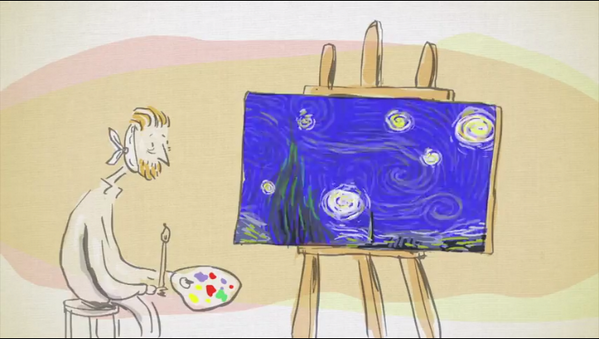
If you’ve taken a good art history course on the Impressionists and Post-Impressionists, you’ve inevitably encountered Vincent van Gogh’s 1889 masterpiece “Starry Night,” which now hangs in the MoMA in New York City. The painting, the museum writes on its website, “is a symbolic landscape full of movement, energy, and light. The quietness of the village contrasts with the swirling energy of the sky.… Van Gogh’s impasto technique, or thickly applied colors, creates a rhythmic effect—the picture seems to constantly move in its frame.” Artistically, van Gogh managed to capture movement in a way that no artist had ever quite done it before. Scientifically, it turns out, he was on to something too. Just watch the new TED-ED lesson above, The Unexpected Math Behind Van Gogh’s “Starry Night.”
Created by math artist/teacher Natalya St. Clair and animator Avi Ofer, the video explores how “Van Gogh captured [the] deep mystery of movement, fluid and light in his work,” and particularly managed to depict the elusive phenomenon known as turbulence. In Starry Night, the video observes, van Gogh depicted turbulence with a degree of sophistication and accuracy that rivals the way physicists and mathematicians have best explained turbulence in their own scientific papers. And, it all happened, perhaps by coincidence (?), during the turbulent last years of van Gogh’s life.
Note: An earlier version of this post appeared on our site in 2014.
If you would like to support the mission of Open Culture, consider making a donation to our site. It’s hard to rely 100% on ads, and your contributions will help us continue providing the best free cultural and educational materials to learners everywhere. You can contribute through PayPal, Patreon, and Venmo (@openculture). Thanks!
Related Content
1,000+ Artworks by Vincent Van Gogh Digitized & Put Online by Dutch Museums
Vincent Van Gogh’s “The Starry Night”: Why It’s a Great Painting in 15 Minutes
Discover the Only Painting Van Gogh Ever Sold During His Lifetime
The Met Releases High-Definition 3D Scans of 140 Famous Art Objects: Sarcophagi, Van Gogh Paintings, Marble Sculptures & More
