

Get stories like this delivered straight to your inbox. Sign up for The 74 Newsletter
Letting students decide how they learn is almost as important a goal of Mayfield High School near Cleveland as learning itself.
The school lets students skip traditional classrooms and lectures if they don’t fit how a student learns best. They can work independently at their own pace, earning credit based on what they learn, not for sitting in a class all year.
Or students can leave school each afternoon to complete a paid internship, earning credit for what they learn in the workplace.
Mayfield High School, with an enrollment of 1,200 students, is one of many high schools across the country increasingly offering students flexibility to shape their class schedules and how they earn credits toward diplomas, as career demands keep shifting and students grapple with family and life challenges.
It’s an approach that has grown as students mix high school classes with early college courses or seek different ways to try out jobs and train for them, none of which fit neatly into days divided by class periods.
“Let’s be real, our students have many more responsibilities in today’s world than we did back in the day,” said principal Brian Linn added. “They may be working to support their family. They may need that internship, because they need to go right into the world of work.”
Students “live in a personalized world outside of school,” said Linn, “so we have to personalize (school) to meet their needs.”
It’s a shift that has drawn praise from national education advocates, including the XQ Institute and Battelle for Kids. Personalized learning has also become a greater priority for states, including Indiana, Vermont and Virginia, while schools that adopt the approach are cropping up from Washington, D.C. to greater Chicago.
Two new paths have taken hold at Mayfield High School with this flexibility:
- A Learn and Earn program that offers 127 of the school’s 1,200 students paid internships in fields such as manufacturing and construction. Students often pick the chance to learn on the job over being trained in a trade in a school workshop as part of a career technical education program.
- An alternative schedule and class experience that gives students more independence, simply called The Option. It’s a mix of study hall and class time with its own open space as big as a gym where students can do as much math or English as they want each day, as long as they finish all their work each week.
“We wanted to create a self-paced option for students,” Linn said. “To be very frank, we couldn’t think of a better name for it, so we called it The Option.”
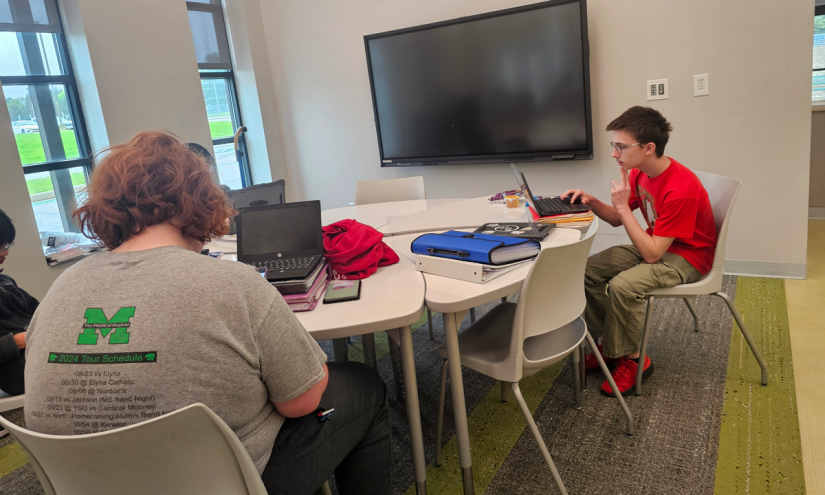
It’s a program about 20% of the school’s students choose over taking classes the traditional way, with teachers leading a lesson. The Option allows them to do classwork at their own speed, while teachers act as guides instead of lecturers. Students read materials or watch videos, then answer questions or write about the lessons independently, seeking teachers when they need help.
“Option time, for lack of a better word, is a structured study hall,” said Paige Zenovic, an English teacher who chairs the program. “It’s basically the idea that the students are with their teacher for study hall.”
Students study multiple subjects – such as math, English, history — all within The Option’s high-ceilinged study space larger than a basketball court that was once a building trades workshop. It’s now renovated for tables that seat a handful of students and with a balcony and wide staircase where students can work.
Mayfield High School students can spread out all over a gym-sized room in The Option, including this open staircase to a balcony. (Photo by Patrick O’Donnell)
Teachers for multiple subjects are based there, so they and students can interact whenever they are there about any option classes at any time. Lessons are given to small groups of students and sometimes just in one-on-one sessions, in this version of what some call a “flipped classroom.”
“You just will not see a 50-minute specific lecture with 25 students in the class,” Linn said. “You’ll see one 10- to 15-minute mini lesson.”
Superintendent Michael Barnes called The Option a “fully customizable” school day that lets students pick what subjects to work on when, so long as regular assessments show they are on track in a limited form of mastery-based learning, in which students work on academic material until they know it and can show competency in it.
“We allow our students to exercise agency over their own learning so they have voice and choice,” Barnes said. “They set their schedule every single day. They can determine what they want to work on, when they want to work on and when they want to assess.”
That independence helps teach students responsibility to do their work and time management skills.
“That’s a really important piece that doesn’t typically happen in the traditional class, because everyone’s supposed to be doing the same thing,” Zenovic said.
Because The Option is voluntary, students can choose to return to traditional classes. Some do, but many continue it all through high school. Senior Giovanna Zahedi has used The Option all four years of high school because she considers lectures unfocused and rambling.
“I find it really hard to concentrate in classrooms,” she said. “I just want to get straight to the point, just finish my schoolwork.”
Sophomore Madilyn Senning splits her classes between traditional classrooms and The Option, but says she prefers The Option.
“I have a hard time focusing when they’re lecturing the whole class,” she said. “I can work ahead, because a lot of the time I get things done faster than some other people in my classroom. It’s just easier for me to get my work done.”
The Option is joined by Learn to Earn as the two most aggressive ways the school gives students choices.
The school belongs to a consortium of 10 suburban school districts that share career technical education classes such as welding and auto repair between them. But those have become so popular that 17 out of 19 CTE programs are oversubscribed and turn students away. Welding, for example, has room for 35 students but had 175 applicants this year.
“We don’t want to have to tell a student, no,” said Deanna Elsing, the school’s director of innovation.
“A typical high school isn’t in a position to build a million plus dollar facility…to support the needs of our students’ personalized interest,” Elsing said. “But for the bargain price of free, we can partner with local industry, organizations and businesses and they can become the classroom.”
So Elsing started recruiting local businesses to bring in student interns — and pay them. That’s rare nationally, with fewer than five percent of high schoolers doing an internship or apprenticeship before graduating, according to federal data and surveys by the American Student Assistance nonprofit, now known as Britebound.
Started with just nine students three years ago, Learn and Earn now has 127 — about 10% of the school — doing internships in fields that include welding, manufacturing and home construction.
The program is open to juniors and seniors, who spend their first semester learning workplace etiquette, doing tours of companies and hearing presentations from different businesses. They then move on to working about 20 hours a week for businesses over the next year and a half, often including summer work.
That meant the school altering its schedule so the students can take academic classes in the morning, leave by 11:45 a.m. and be at their internships by 12:15. That lets them work all afternoon, often staying after school hours to keep working until the end of the work day, as many employers requested.
The school also added training sessions for employers, not just students, before interns would start at a company.
“It’s so important for our students to be able to look someone in the eyes, shake their hand, dress appropriately, test drug free, and have those professional skills,” Elsing said. “But we found over the last three years that some of these industries have not quite yet mastered how to properly engage and train a Gen Z or Gen Alpha student. Because they are 16, 17, 18-year-olds, they’re not going to come in as polished as your college graduate is going to come in.”
Jacob Reed, 19, who graduated from the high school last May, started working for nearby Kerek Industries, a manufacturer of parts for municipal transit systems, about 20 hours a week as an intern his junior year, continued as a senior and was hired after. He now works part-time while studying engineering at the local community college.
“I’ve already been in a professional work environment for over two years now, so I know what it’s like working jobs, coming every day, knowing what’s expected of me,” he said. “I think that gives me a leg up for sure.”
Mayfield High School graduate Jacob Reed started work for Kerek Industries as an intern while in high school and has stayed on as an employee even after graduating. (Photo by Patrick O’Donnell)
The company even adjusted his work schedule to accommodate final exams and for practices and games for the school’s football team. Because he could leave school to start work around noon, he could leave at 3 p.m. for practice.
Company owner John Kerek said he knows he has to train students more than when hiring adults, but he said manufacturing companies need employees and everyone has to start somewhere.
“I expect from day one I’m going to start at the very ground-level basics of ‘This is a machine shop..this is what this machine is capable of doing…this is what we’re using it for. ..this is how we check the parts that it’s making,” Kerek said. “I’ve learned repetition is key. The more I say something, the better it sticks, and the more I let them fail a little bit, the better it sticks too.”
Senior Mackenzie Lofton has a very different internship learning how to be a project manager for a construction business through the Brookes & Henderson Building Company, a builder of luxury homes. He first tried to do the traditional construction trades program through school, but too many students applied and he was shut out.
He has no regrets. Officially, he is a laborer that does low-skill jobs at houses under construction around the region. But the company is also giving him a look at construction he’d never see in class — how to run a project.
Zak Mowry, the company’s operations manager, said schools are good at teaching students specific trades, such as carpentry, electrical or plumbing work. But schools, he said, don’t provide an overarching look at how to plan and manage all those trades to finish a home.
So most days Mackenzie sweeps floors and moves construction materials to help skilled workers. But he is also invited to company meetings to plan houses. And every Thursday, he shadows managers as they oversee different aspects of construction, ranging from foundations to heating and cooling. The company even created a hardcover manual and workbook for interns that explains key terms for each specialty and has questions they answer after each shadowing day.
Mayfield High School senior Mackenzie Lofton discusses plans for a $22 million house he is helping build as part of his Learn and Earn internship. (Photo by Patrick O’Donnell.)
“You see all the trades come into action,” he said. “ So you see the foundation being made, you see the electrical running wires, you see the plumbing coming in, you see all the hardware coming in. All those things that are behind the scenes, you get to see out in the field that they don’t teach you in the classroom.”
Just as importantly, Mackenzie is learning management skills by watching managers navigate disputes between different trades, architects and customers on multi-million dollar homes.
“I feel like I have way more experience because I’m actually in the field, while they’re just learning in classrooms,” he said. “You’re interacting with people, getting your social skills up. You also have to be on time, so you’re becoming more responsible as a man and as a person.”
Disclosure: XQ provides financial support to The 74.
Did you use this article in your work?
We’d love to hear how The 74’s reporting is helping educators, researchers, and policymakers. Tell us how
