

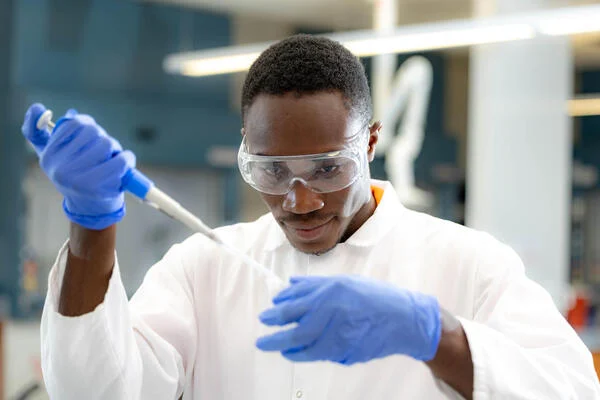
Many institutions rely on unpaid undergraduate research, which can limit participation for low-income and first-generation students. But at Soka University of America, undergraduates can take part in a fully paid research assistantship program, gaining hands-on research experience while still earning income.
The private liberal arts college in California’s Orange County provides students with roughly 10 hours of research each week during the academic year and between 20 and 40 hours per week in the summer. Students are paid the statewide minimum wage of $16.90 per hour.
About 40 students participate during the academic year, with roughly 30 continuing into the summer, said Robert Hamersley, dean of faculty at Soka. The program allows full-time and visiting faculty to each work with one student during the academic year and up to two full-time students in the summer. Projects span disciplines from philosophy and the social sciences to the natural sciences.
Hamersley said the academic-year program has been in place for about 15 years, and the summer model is entering its third year. The approach is designed to address equity gaps in access to workforce training while also responding to students’ growing demand for career-aligned learning.
Research shows increasing interest in such programs; Inside Higher Ed’s recent Student Voice survey of more than 1,000 students at two- and four-year institutions found that about 80 percent are at least somewhat interested in work-integrated learning. Among those who have already participated, 82 percent said they want more of it in the future.
Hamersley said the goal is to ensure that students are meaningfully engaged in research, rather than given support roles.
“What we’ve been trying to avoid is the kind of work where students are doing clerical tasks or simply supporting the faculty member. We’re trying to get them involved in a research project,” Hamersley said. “We don’t want students just being paid to wash dishes in a laboratory or do data entry—we want them to be engaged early on in projects they’re invested in and have some agency over.”
The experience: Soka was founded in 1987 and established on its current campus in 2001 by Daisaku Ikeda, founder of the Soka Gakkai International Buddhist movement. The university is grounded in principles of peace, human rights and the sanctity of life and offers a nonsectarian curriculum open to students of all nationalities and beliefs.
Hamersley said those founding principles continue to shape institutional decision-making, including the emphasis on paid research assistantships designed to remove financial barriers and expand access to high-impact learning opportunities.
“When you’re thinking about how to encourage student success, getting involved in research—and especially being able to present that research at conferences—is a really key thing,” Hamersley said. “Not only can students put it on their résumé and maybe applications for graduate school, but they get a chance to work very closely with faculty, which really increases the strength of the letters of reference that faculty can write for them.”
Hamersley said the university’s paid summer research program was initially supported by a $1 million grant from the John Stauffer Charitable Trust, which established an endowment for student research in chemistry and biochemistry. A university board member later contributed additional funding through the Luis & Linda Nieves Family Foundation to expand the opportunity across disciplines.
He added that the model has shown promising outcomes, including high rates of graduate school placement and jobs with research-driven organizations.
“Our students are getting a lot of research experience during the year, and that helps them be able to work during the summer,” Hamersley said. “I certainly expect the ones that do research are more likely to be going on to graduate school.”
Why this matters: Hamersley said paid research can serve as both an equity lever and a workforce pipeline strategy and argued that compensation should become the norm rather than the exception in undergraduate research programs.
He also noted the model is relatively scalable, particularly for small liberal arts colleges looking to expand high-impact learning without significantly increasing administrative overhead.
“It doesn’t have a lot of overhead … and compared with the operational costs of the university, this is small potatoes,” Hamersley said. “It’s not a lot of money to give a student 10 hours a week of research experience.”
“We’re not unique in this, but we make a real point of saying that we’re a student-centered institution,” he added. “It’s the No. 1 purpose we have for existing, so really, for us, a measure of our success is how our students are doing and what kind of experiences they’re having.”
Get more content like this directly to your inbox. Subscribe here.
